
You have to remain alert if you want to catch any of Rohmer's quirks. Here are a few I spotted:
A chapter that begins: “To sum up the main points of the briefing Mr. President…”
Hyperbole: “I think it’s safe to say that the next six days will be the most crucial between the Americans and the Russians since World War II.”
Uninformed politicians: President Hansen discovers that the Chairman of the Joint Chiefs of Staff objects to the Pakistan deployment by reading about it in The New York Times (which in turn considers the story warrants no more than a small article beneath the fold).
Stupid politicians: While Hansen is certain that the Soviet Union is the only country processing the ability to sink twenty supertankers in the Atlantic, he doesn’t rule out “revolutionaries”.
Inconsistency: Is it Japanese Red Brigade or Japanese Red Army?
Forgetfulness: What do those Germans call themselves? Badd…? Badder…? Screw it, “the dreadful gang of German revolutionaries” and “the German revolutionary group” will do.
Weirdness: Much like Thomas Jefferson and Canada, Chairman Romanov is certain that taking over the Middle East will be a mere matter of marching.
Finally, we have the significance of race, blood, or in this case genetics:
Said was a Palestinian Arab. And yet he also carried an unusual genetic strain of which his blue eyes were the manifestation. It was this combination that set him apart and provided for him special initiatives. He thought as did his Arab fellows but unlike them he did not rant, rave and merely talk. He could act.Here’s Said with Captain Rashid as imagined by

True, Periscope Red lacks a protagonist, but then À rebours has no plot. Consider it an experiment. For the first time Rohmer abandons no threads. All thin, they simply run along, barely rising or falling. And while they’re not exactly tied at the end, they do touch. That is, if one forgets that Periscope Red is the sequel to Balls!
Remember how that ended?
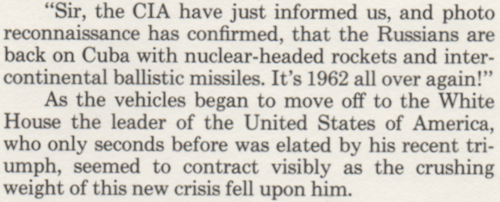
Periscope Red begins twenty-three days later. What happened to the missiles in Cuba? Why no talk of the deadly natural gas shortage? You’d think that the Ruskies blowing up supertankers would put an end to the glut that the US sought to exploit? And, really, what's the point of spending all that money on ships only to see them sink?
Here's my theory: Balls! hit bookstores in August 1979, two months before the Soviet intervention in Afghanistan. Rohmer decided that real life was far better than his Cuban Crisis Revisited idea. Bonus: All his thinking about World War III would still apply.
A parting query regarding Yasser Arafat: Am I right that Periscope Red is the first Rohmer novel to feature a real person?
And is that not the same Yuri Andropov we grew to know and love during his final fifteen months? Perhaps not, before becoming Chairman ours headed the KGB, not the Red Army. I'm betting Rohmer was just drawing upon names he knew - hence Romanov, Smirnov, Ustinov (but not Nabokov, Bulgakov or Chekhov).
Sayeth General Andropov:
The Americans never cease to amaze me with their inability to plan ahead for this sort of crisis. They seem to be completely incapable of doing any sort of long-term planning.Yep, every Rohmer plot tells us as much.
Triad? Of course, 'cause, you know, it’s the sequel.
