Showing posts with label Balls!. Show all posts

Monday, 24 November 2014


I raced through Sir John A.'s Crusade, but only because the copy I had was an inter-library loan and could not be renewed.

Here are a few things to look out for:

Bullshit
Rohmer imagines at least two characters – Robert Wilmot and George-Étienne Cartier – uttering the word. Fathers of Confederation both, I felt this was in poor taste, doubly so since its use can be traced back no further than 1915 America.

Errors in calculation
Foul-mouthed Cartier pegs Macdonald's age at 52. In fact, he was 51.
     Macdonald describes the year in which all action takes place as the twenty-ninth in Victoria's reign. In fact, it is the thirtieth.

Exclamation marks
I'm certain that there are more here than in any other Rohmer novel.

Kelly
Rohmer likes to position himself as something of a seer.
     "Balls!" you say. "The man couldn't have been more wrong about the Soviet Union."
     "True enough," I reply, "but consider last week's events in Buffalo. One of the dead was found in a car covered by snow."
     As if further evidence was needed that Rohmer is in tune with Geller, I point out that Sir John A.'s Crusade features a villain with the very same surname as one of his future critics.

Resplendent
Reading Richard Rohmer, you begin to recognize common threads. Vodka and how to dull its effects is one example. Not everything is so obvious. It wasn't until Sir John A.'s Crusade that I first noticed "resplendent", a word I don't think I've ever used in my own writing.
     Going back, I see that it was there from the beginning. In Ultimatum we find members of the RCMP "resplendent in their traditional red-coated uniforms". It's used in describing Patton's garb in Patton's Gap. The word appears in Red Arctic and – spoiler – Rohmer's biography of E.P. Taylor. Resplendent is used four times in Generally Speaking. It also appears four times in Sir John A.'s Crusade. Which brings me, finally, to…

Fetishism
You'll not find so shameless a display of perversity as this passage from Sir John A.'s Crusade:
The Right Honorable Henry Wellesley, Earl Cowley, was resplendent in his ambassador's uniform. He wore a black jacket, with a high collar and epaulettes; the gold braid decorating it was enhanced with royal reds and blues. A crimson sash crossed from the right shoulder to the opposite hip; half a dozen medals on multi-coloured ribbons were pinned to the left side of the jacket, over the ambassador's chest. Below them sat thge star of his rank with which his Queen had vested him. His black trousers bore wide gold stripes down the outside seams. Those stripes disappeared into highly polished half-Wellington boots.
     A short ceremonial sword in an elaborately engraved and embossed scabbard hung from a broad gold-decorated belt that encircled Earl Cowley's considerable girth. On his head sat, foursquare, a large black cocked hat covered with more gold braids, its forward point jutting straight out from his wigless wide forehead. Across the hat's crest several white plumes…
There's more, but you get the picture.

Lest you wonder, I don't mention the "busby-capped soldiers of Her Majesty's Grenadier Guard" because "resplendent" is not used.

Yes, I am hurt.

Friday, 5 September 2014

I've got to disagree with Brian, when he suggests that the cover of an exposé like Massacre 747 should have at least a passing resemblance to the incident described inside.  Not the point at all, as the Master himself explains in How to Write a Be$t $eller:


"The objective of the artwork is to make the jacket eye-catching, to make it catch the browser’s roving eye. After all, if he doesn’t stop and look, he’ll never pick up the book, which is what you hope he’ll do next.  Once he has it in his hand, he will be entranced and captivated by the artwork and the kaleidoscope of seductive colors and suggestive intertwined forms…"

You're getting hung up on details.  Where the Russian plane was and what the pilot could see when he shot down Flight 007.  (Although that's the alleged point of Rohmer's book.) As Ronald Reagan once explained, "facts are stupid things."

I think Massacre 747 has the best -- coolest, least-amateurish -- cover of a Rohmer since the American paperback of Ultimatum.  The rest of Rohmer's covers run the gamut from botch to disgrace.  The effect of the average Rohmer cover is to make you think design is impossible.

Have you ever been in an Abercrombie & Fitch?  They smell bad, the music is terrible, and the walls are covered in photographs of hulking, shirtless teenage creeps.  And you think: I get the message, but you're working way too hard to get me not to shop here. 

Like the cover of Periscope Red.  Message:  I asked a dimwit to draw this cover with his left hand. Please don't read this half-assed book.  It will only make you sad.

I guess Balls! is okay.

Thursday, 8 May 2014

I've just realized that Periscope Red opens on 9 March, twenty-four hours (more or less) before the beginning of Triad.

Bloody hell.

Here's the thing about Rohmer, one of his greatest weaknesses stems from wanting to set things in the near future. Very near. He moves in as close as possible, yet still misses the mark. Where any other writer would continue – this is fiction after all – Rohmer feels he must realign with reality.

Balls!, published eight months before the 1980 Quebec Referendum, imagines a world in which federalist forces lose. Rohmer was wrong, of course, but I've read The Man in the High Castle and am interested in seeing where this could lead.

(Not to suggest that the péquistes are fascists, you understand. Rohmer's is the party of Lévesque, not Marois.)

So, the Canada of Balls! is disintegrating – in Periscope Red mention of its existence is limited to a stray sentence – yet Triad, written after referendum, has the Dominion as healthy as ever.

For an author so intent on pursuing American sales this miscalculation is but a trifle. Rohmer's big problem rests with Balls!, which had Hugh Barker, the 40th President of the United States dying in a snowdrift. The tragedy is so recent that it is referenced in Periscope Red, yet Triad has Ronald Reagan as the fortieth.

This brings me to Peter Lockhart, the bland, blue-eyed Albertan who was Prime Minister of Canada in Balls! How is it that in Triad, which begins just four weeks later, the office is held by Pierre Trudeau Louis Turcot?

Wednesday, 9 April 2014

Agreed. The fun is gone, but only because Periscope Red is the most competent Rohmer thus far — by far. President Hansen holds meetings, but we read nothing of their scheduling; his Diego Garcia conference comes as a complete surprise. Where’s the flight plan? What happened to that Air Force One cut-away? Did McClelland & Stewart refuse to give it up? Facts and figures are repeated only once or twice (okay, three times… but no more), and I can’t find any filler at all. Quite an accomplishment when one considers this was the longest novel to date. Bigger than Balls!

You have to remain alert if you want to catch any of Rohmer's quirks. Here are a few I spotted:

A chapter that begins: “To sum up the main points of the briefing Mr. President…”

Hyperbole: “I think it’s safe to say that the next six days will be the most crucial between the Americans and the Russians since World War II.”

Uninformed politicians: President Hansen discovers that the Chairman of the Joint Chiefs of Staff objects to the Pakistan deployment by reading about it in The New York Times (which in turn considers the story warrants no more than a small article beneath the fold).

Stupid politicians: While Hansen is certain that the Soviet Union is the only country processing the ability to sink twenty supertankers in the Atlantic, he doesn’t rule out “revolutionaries”.

Inconsistency: Is it Japanese Red Brigade or Japanese Red Army?

Forgetfulness: What do those Germans call themselves? Badd…? Badder…? Screw it, “the dreadful gang of German revolutionaries” and “the German revolutionary group” will do.

Weirdness: Much like Thomas Jefferson and Canada, Chairman Romanov is certain that taking over the Middle East will be a mere matter of marching.

Finally, we have the significance of race, blood, or in this case genetics:
Said was a Palestinian Arab. And yet he also carried an unusual genetic strain of which his blue eyes were the manifestation. It was this combination that set him apart and provided for him special initiatives. He thought as did his Arab fellows but unlike them he did not rant, rave and merely talk. He could act.
Here’s Said with Captain Rashid as imagined by a high school student an anonymous Globe & Mail illustrator (4 September 1980 edition):


True, Periscope Red lacks a protagonist, but then À rebours has no plot. Consider it an experiment. For the first time Rohmer abandons no threads. All thin, they simply run along, barely rising or falling. And while they’re not exactly tied at the end, they do touch. That is, if one forgets that Periscope Red is the sequel to Balls! 

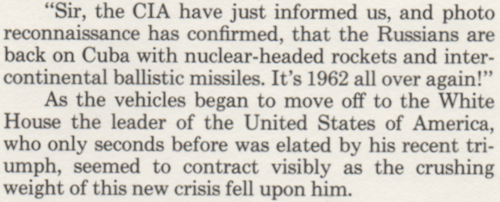
Remember how that ended?


Periscope Red begins twenty-three days later. What happened to the missiles in Cuba? Why no talk of the deadly natural gas shortage? You’d think that the Ruskies blowing up supertankers would put an end to the glut that the US sought to exploit? And, really, what's the point of spending all that money on ships only to see them sink?

Here's my theory: Balls! hit bookstores in August 1979, two months before the Soviet intervention in Afghanistan. Rohmer decided that real life was far better than his Cuban Crisis Revisited idea. Bonus: All his thinking about World War III would still apply.

A parting query regarding Yasser Arafat: Am I right that Periscope Red is the first Rohmer novel to feature a real person?

And is that not the same Yuri Andropov we grew to know and love during his final fifteen months? Perhaps not, before becoming Chairman ours headed the KGB, not the Red Army. I'm betting Rohmer was just drawing upon names he knew - hence Romanov, Smirnov, Ustinov (but not Nabokov, Bulgakov or Chekhov).

Sayeth General Andropov:
The Americans never cease to amaze me with their inability to plan ahead for this sort of crisis. They seem to be completely incapable of doing any sort of long-term planning.
Yep, every Rohmer plot tells us as much.

Triad? Of course, 'cause, you know, it’s the sequel.

Sunday, 16 March 2014

So, we're finished with book #6, right?

Of the twenty-five or so remaining Rohmers, the one I most want to read is How to Write a Bestseller, because Balls! has planted an idea: Rohmer begins his books with the ending in mind, but has no clue as to how he’ll reach same. This hardly matters because every false start and each dead end contains something he wants to impart. I doubt the man has ever cut so much as a sentence in his entire career.

Balls! is the least Canadian Rohmer thus far. The novel’s hero, Sam Harris Joey Kowal Hugh Baker John Hansen Mark James, is an American. Canada doesn’t even come into play until page 163. Though White House staff advise otherwise, Albertan Peter Lougheed Lockhart, the prime minister, is a patsy, always at the ready to fly down to Washington. Hansen calls him Peter; Lockhart calls Hansen Mr. President. That the prime minister's unfounded fears of American invasion and annexation prove to be correct is a fluke, supported by the author's oddly skewed world view. In Rohmer’s geopolitical reality, Canada is in a perpetual state of threat because the Americans want our energy. The reaction of the Soviets, the United Kingdom, the Commonwealth, and the United Nations to American invasion and annexation is never considered.

A queer anti-government vein runs through Rohmer's big Balls! (his biggest novel thus far). TransState shuts off the heat in 350,000 homes before bothering to inform New York's Governor Sharpe. Company president Sam Harris is kind enough to offer advice: “The question of how to handle this from the people’s point of view – emergency measures, the National Guard, the Army, the federal government, police, traffic, telling people what to do and getting them organized – that’s your bag, sir.”

Uncle Mike talks back to the TV, demanding that Sharpe fix an hours-old crisis that is the fault entirely of private industry. Meanwhile, nephew Joey announces that he will not - will not! - take his wife and infant twins to an emergency government shelter. He gives his brilliant middle finger to the Governor, Sharpe's advice and his offer of support, then takes to the road in a dangerously overloaded station wagon. Minutes later, finding himself stuck in a supernatural snowdrift, Joey expects government rescue. It never comes. So much for the Nanny State.

I wonder whether Joey’s lack of faith in Sharpe might have something to do with the fact that Rohmer's leaders of men, businessman and politicians exclusively, are forever throwing hyperbole into hyperdrive:
  • “What we’re listening to is probably the most important decision outside a declaration of war,” says swinging bachelor Angelo Grazzi as his company shuts off supply lines.
  • Governor Sharpe considers the loss of heat in 350,000 homes “the most profound crisis and emergency the country has ever seen.” He will later describe same as “the worst single disaster that has ever occurred in this country.”
  • Vice-President Mark James tells the President that the country may be at “its weakest point since the Revolution.”
The Civil War can’t compare. American lives lost in the Spanish Flu Pandemic are forgotten.

The greatest tragedy in Balls! is that the Buffalo Disaster could have been avoided if only the President had chosen a career the energy industry instead of politics. Don't take my word for it - no less an expert than Petro-Canada president Bill Hooper describes the politician's off-the-cuff tanker plan as “Clever, very clever. Ingenious!”

What is that plan? Purchase and retrofit underused ships to carry natural gas.

Of course! [head slap]

The United States government will do what the private sector won’t. It will spend billions to get gas to Americans, righting a dangerous situation created by the energy companies. Lest you think that the country is descending into socialism, Vice-President James reassures: “We believe in the free enterprise system. So we’ll get out as quickly as we can.”

God Bless America.

Q: If, as Governor Sharpe states, the lives of close to a million Americans in Pennsylvania, Ohio and New York State are at risk, how is it that loss of life is limited to the City of Buffalo?

And on that note, the revised Richard Rohmer Body Count:
Ultimatum: 1
Exxoneration: 200 (approx.)
Exodus/UK: 18*
Separation: 5
Separation Two: 1**
Balls!: 19,228***
* 17 according to Separation;18 according to Separation Two.
** does not include deaths first described in Separation, which is “the same book, yet different.”
*** may or may not include the 40th President of the United States.

Thursday, 13 March 2014

Those last two posts were great - what more can I add about this ludicrously disjointed book?

I would say spoiler alert here,  but I'm not convinced anything we've blogged has led a single person to try reading any of these books.  Ah well, dear readers - we are doing this for your benefit and no one said it would be easy.

So what do have here: a main character (Sam Harris) who turns out to be just in the wrong job at the wrong time and his story ends somewhere in the middle of the book.  An entire social-realist interlude with the extended Kowal family who rather abruptly freeze to death after their story is abandoned in a snow drift.  Why are they in the story at all?  So surviving father Joe can show up and shoot that weasel Schmit, that's why.  Schmit, by virtue of the fact there isn't another one, is the book's de facto villain.  How bad is he?  He smokes in the presence of non-main-character Sam Harris, annoying him to no end.

And so that must mean that President Barker is the book's main character.  He gives it a go, but ends up dying of a heart attack around the middle of the book as well.  So I guess he and his virile successor, President Hansen, share main character duties.  Unless you count globe-trotting, deal-making vice-president James.  

But let's do this in order:

1. Brian - I want to second your suspicion that brilliant young lawyer Joey Kowal is a moron:  faced with crippling cold, a family to save and a half a tank of gas to do it with, he takes a stand about going to a shelter - like that would likely be the worst possible choice he could make.

2.  Did they have to cut off the gas completely?  Couldn't they have done rotating cuts in the region?

3.  Once President Hansen comes up with his brilliant secret plan to insure there will never be another Buffalo, what is the first thing he has the VP do?  Why, fly north to Melville Island to "get a look at"  the energy installation there.  Why?  Well if it was good enough for President Blank in Ultimatum, it's good enough for VP James.  Once again we are subjected to another high-ranking US official flying to Northern Canada in the middle of a crisis so we can get pages and pages of descriptions of how energy is being processed.  And there isn't a single bit of information he couldn't have got from the blueprints he asks Hooper for.

R-RATED ROHMER

So this marks yet another step forward for Rohmer allowing actual scenes of romance, seduction and L-U-V to intrude on the main energy story.  As outlandos d'amour VP James and his sidekick Katz fly around the world trying to finish a business deal (there - the last 100 pages summarized for your convenience), we get to see them engaged in a little cat-and-mouse game with the US Ambassador and her secretary.  Of course it's ridiculous - James and Ambassador Hunt meet, fall in love, have a torrid affair and agree to marry - in about 24 hours.  "But - she's a democrat!"  teases President Hansen as the two engage in good-natured guy talk.  James Carville and Mary Matalin they ain't, but I'll try and be kind here and say at least when Rohmer decides to write relationship stuff, no one talks about how many trillion cubic feet of natural gas the US will need to make sure there isn't another Buffalo.

And for the second time, a scene caused me to laugh out loud on the bus:  VP James is in London, and calls President Hansen to give him an update: "The President sounded mellow and happy despite the hour. James didn't know, although he might have guessed, that John Hansen had just been through one of those delicious wake-ups that his young wife was so good at.".

 "although he might have guessed"???? What?  The two barely knew each other before they ended up becoming President and Vice-President.  It's 7:15 in the morning - is that really the first thing that would have crossed his mind?

Wednesday, 12 March 2014

Last night I read another sixty pages of Balls! Tough going, it was nowhere near as exciting as Joey Kowal’s lengthy Ponce de León-like quest for extension cords.

Having reached page 239, I have a horrible feeling that I’ve read the last of the Kowal clan. Still, I hold out hope. After all, is there not something magical in their journey? Consider Joey’s station wagon, which can burrow “like a huge mole”. What of the enchanted snowdrift that envelopes the Kowals, protecting them from the horrors and cold of the outside world? How long before the White Witch makes an appearance? How about Mr and Mrs Beaver? Tumnus is sure to alert Aslan to their plight.

I don’t mean to go all Edmund here, but I’m grappling with a loss of faith. Pray forgive me for thinking Harvard Law School graduate Joey Kowal is a dim bulb.

Evidence:
  • Though Joey and his kin are secure, if uncomfortable, in his parents’ duplex - the one they bought in 1950 (p.69), the one they’d decided to buy (p.70), the one with the price that was right (p. 70), the one they chose to buy (p. 70) – he believes that the best course of action is to leave.
  • Faced with the worst winter storm in Buffalo’s history, he decides to take to the road in an overloaded station wagon carrying five adults and two infants (intending to pick up Papa Joe along the way).
  • Though there is “gasoline rationing in Buffalo and throughout the United States”, Joey thinks he’ll be just fine with half a tank.
  • Lawyer Joey decides on a southern route to Florida (1775 km), even though Canada - which is untouched by the TransState Gas Distribution Corporation cut-off is just a couple of kilometres to the west.

I lived in Toronto for four years, and it’s just shy of six since I moved to St Marys, yet I’ve still not visited Buffalo (a mere 2 ½ hours south-east). I now know to wait until spring. Here are other things I’ve learned about the city from Balls!:
  • All buildings in Buffalo – be they detached Victorian Italianate, mid-20th-century condo, high school or government edifice - are heated by natural gas. No oil. No electricity, either.
  • Not one residence in Buffalo features a fireplace. Houses have no insulation and paper thin exterior walls.
  • Water freezes more quickly in Buffalo than it does in the rest of the world.
  • Buffalo’s electrical grid is second to none.

Here are a few other things I've learned through Balls!:
  • Should disaster befall an area between Election Day and Inauguration Day it falls on the President-Elect to declare a state of emergency.
  • The United States National Weather Service provides thirty-day forecasts.
  • One thing more boring than reading a travel itinerary is an account of how same came together. 
  • Smoking is bad.
  • Conservationists are emotional.
  • Sam Richardson is black.

Just over one hundred pages remain.

Saturday, 8 March 2014

I devoured the last of Richard Rohmer's Balls! in one sitting last night.  And with that fresh in my mind -- and the horror of the image fresh in yours -- here are my thoughts:

Sir Michael Wilson and Qasim Khan (the man with hooded eyes; The Cobra)

On page 12 of Balls! we are introduced to Michael Wilson, ship broker, and Qasim Khan, ship haver.  Qasim has heard a rumor that pretty soon someone's going to be needing tankers in the worst way, and Qasim wants to make sure Wilson brokers his first.  Qasim threatens to blackmail Wilson if he doesn't get the message and do what he's told when the time comes.

This never comes up again.

Does Qasim know Buffalo's about to get a President-killing snowstorm that will turn America from a nation of many needs, abilities, gifts, dreams etc., into a entity only interested in buying tankers?

If so, how does he know?  Does he own a weather machine? Would a weather machine be more valuable than a boat? If you owned a weather machine, would you use it to attack Buffalo, in order to sell more boats?

Sam Harris, Oil Man

Vanishes, with a golden parachute, on page 175, never to be seen again.

I think the disappearance of Qasim Khan is just one of those things that makes Rohmer Rohmer.  It's like Glenn Gould's grunting.  Abandoned plot threads are part of the fun.  Like getting the same information a half dozen times, or the inevitable appearance of the Mackenzie Delta. (Page 226)

I think the disappearance of Sam Harris -- oil genius/sex machine -- and the appearance of George Stratton -- oil genius/sex machine -- is something else entirely.  It's evidence of a heavy (and hacky) rewrite.

I think the whole book is about Sam Harris, president of TransWhathamacallit,  and "George Stratton", Vice President of the United States, is his Tyler Durden.  Same guy, different name.  And the result of a really late-in-the-game overhaul.

Here's a story that kinda makes sense:  Sam Harris runs an oil company.  They fuck up (or get attacked with a weather machine) and kill almost everyone in Buffalo, NY.  Sam Harris decides that will never happen again, and sets out to buy thousands of oil tankers and convert them to LNG tankers.  He does, the end.  (Yes, that's a lame ending.  But all Rohmer business deals have the same lame ending.  This guy flies around asking people to sell him things. They do. Tah-da!)

Here's a story that's a mess:  Sam Harris runs an oil company.  It screws up, and everyone in Buffalo drives their car into the snow.  Sam Harris feels so bad about it, his bosses fire him, because, oh yeah, they also just found out his mother was Jewish.  Sam Harris is never seen again. Meanwhile, the President dies, the new President picks s a completely different natural gas-obsessive, Senator George Stratton, to be Vice President.  The President has a mission for George: America (the country) is going to start buying natural gas by the trillions of cubic feet and America (the country) is going to buy thousands of ships to move it.  So George does just that.  Because he and the President are both Republicans (and so is the Senate and so's Congress, we're told) and they love free enterprise.  A hasty note, very late in the game -- "Oh, yeah, and we'll get the oil companies involved."

It's not just bad storytelling.  It's nonsense.

I think Rohmer wrote another businessman's day dream -- "A guy should buy all those oil tankers and turn them into LNG tankers" and someone (Editor X) told Rohmer thrillers need Presidents.

And maybe some kind of conspiracy?  Or at least a double cross?  Or even a setback?  Anything?  So it's not just:

Hi, will you sell me those tankers?
Yes, I will.
Thank you.
Thank you.

How about a really ugly/beautiful PLO assassin?  Or the most careless hit man in Calgary?  Maybe Balls II?

As Dudley Moore says to Peter Cook, "The main trouble with your story is that it lacks everything."

Air Force One

It was nice to see that Rohmer had improved on Ultimatum by having the President travel by Marine One (which actually exists) rather than his personal Navy helicopter that doesn't.  Also, putting Air Force One at Andrews AFB -- where it is -- rather than Dulles -- where it isn't.  But Rohmer has over-corrected (Glenn Gould: "Hguhnah-uh--uh-uh") and now all airplanes are more or less "Air Force Ones" and he goes out of his way for various cyphers to tell each other the Vice President will be taking the 707 Air Force One -- with its markings painted over! -- and not the 747 Air Force One, or any of the other Air Force Ones that are lying around.

When the President is on a plane, it's designated Air Force One.  When the President isn't on it, it's designated something else.  He also has a plane called Air Force One.  All the other planes aren't Air Force Ones.  They're just planes.  Unless the President gets on them.  Who cares, of course?  But it sounds dopey when Rohmer goes to crazy lengths to get it wrong.

I'll be driving my private car.  It's the 3:15 Greyhound from Amarillo to Dallas.
You'd better have it painted over.
No need.  It's not a bus.  I just call it that.
But not in this case?
Right.  Today it's just my car.

During the last 100 pages of Balls! -- when it became clear that there weren't any twists to the business deal coming, and when it looked like we were setting up to do Ultimatum again, with Canada holding out on the juice, and when he complained about environmentalists again -- for the first time, and I know I'm being childish, I really sort of hated Richard Rohmer.

Friday, 7 March 2014

What's About the Wind-Chill? People Who Take That Into Account in Richard Rohmer's Balls!

TransState Gas Distribution Vice President of Operations Tom Megarry:

"Temperature of ten below and a wind of fifty miles an hour gives a wind-chill factor of, get this Seventy degrees below zero!" (p.41)

Dunlop Tires' Mike Kowals:

"That's nothing, Joe.  On the late news last night they said with the wind-chill factor it's gonna be like seventy below zero..." (p.58)

Maria Kowals, homemaker:

"Yeah, they say it's fifteen below zero and the wind-chill factor makes it about seventy below." (p.64)

Joey Kowals, attorney-at-law:

"With the wind blowing outside and the chill-factor of seventy below zero we'll never get that room above freezing." (p.86)

New York Governor Richard Sharpe:

"On top of that, a large low pressure area has just started to move in across Lake Erie and Buffalo, bringing with it heavy snow and high winds of up to fifty miles an hour gusting to sixty, creating a wind-chill factor in the range of seventy degrees below zero..." (p.99)

The Radio Stations

"The radio stations warned those trapped in cars that the odds against survival for more than ten minutes outside in the prevailing wind-chill factor of over seventy degrees below zero were minimal." (p.117)

Authorities

"Authorities advise that with the current wind-chill factor of over seventy degrees below zero Fehrenheit, no one should go outside unless it is to go to an emergency shelter." (p.122)

Thursday, 6 March 2014

Brian & Stan:

A new book about Nazi rocket scientists arrived in the mail on Monday -- because I ordered it -- and I've been cheating on Rohmer behind his back.  But I promise to take a big bite out of BALLS! between now and Sunday.  Actually, I'd love to finish it.

Holy cow, it's like some really subtle joke on thrillers, though.

Q: What if, instead of plutonium or micro-chips or diamonds, or black-market body parts, or the President's step-daughter, or a hijacked stealth bomber full of missing pages from the Hammer Codex, what interested all these characters was heating Buffalo, NY?
A: That would be pretty boring.

Lou Gossettt made two pay TV movies about postal inspectors -- The Inspectors and Inspectors 2: A Shred of Evidence.  This 1998 article from the Seattle Times can explain it better than I can:

The U.S. Postal Service is backing production of a made-for-TV movie about heroic postal inspectors who track down a mail bomber. "The Inspectors," starring Louis Gossett Jr. and Jonathan Silverman, is scheduled to air on the Showtime cable network Sept. 20.

The movie falls into a television nether world between commercial sponsorship of programming and infomercials, similar to magazine advertorials in the way it blurs lines dividing art and advocacy.
"I don't think it would be a good thing if it became a trend," said Dorothy Swanson, president of the nonprofit Viewers for Quality Television, Inc. ...

Showtime financed the movie's production, while the postal service is promoting it. Television sets in post offices will show clips of the movie, life-sized cardboard cutouts of Gossett in his postal inspector uniform will be distributed and ads will be placed in magazines. (Dan Mihalko of the postal inspector's office) didn't know what the agency was spending for promotion.

"Although we hope to get positive PR out of it, it's not a PR piece," Mihalko said. "It's a thriller based on a mail bomb investigation by postal inspectors. The movie will stand on its own."

Postal inspectors? Meet the gas man.

What I'm noticing 75 pages into Balls! is a tic I had come across before and am only now tracking - Rohmer's penchant for using these tame adjectives that read like they're straight out of company/corporate/organization PR machines to tacitly denote approval for those entities (real or fictional) he likes.  For example, "The document...was prepared by the prestigious Gas Requirements Committee"  or "...Head hunters approached him at the eminent nation-wide firm of accountants, Peat, Marwick," (oddly placed commas intact from original).  There's nothing wrong with this;  it's more like he's making sure that even though some of these people might be villains, there is something fundamentally sound about the corporate world we live in.

The problem with the book so far for me is that it seems to want to be a disaster novel more than a political thriller.  I wish he'd gone that way - his description of the plane crash and the Prime Minister Sands' ordeal was much more convincing in Exodus UK than the political machinations that were the main story.  Also - I know the plight of Buffalo is a way to focus the effects of poor corporate management and government inaction on a real location, but the stakes seem very small this time out.  The fate of countries do not hang in the balance, so it seems more like a (big) problem to solve rather than a crisis.  At least by page 75.

So once again the story begins with a character being told all about himself: George Stratton, remembering the call from President-elect Hugh Barker offering him the job as Secretary of Energy:  "How had Hugh Put it? "George, with your background as one of the most respected academics in the nation and a consultant to many of the world's largest companies in the field of hydrocarbon geology, and with your vast knowledge of business and how the multinationals operate..."  And on and on.

But wait!  What's that on page 39?  A joke about it?  A self-conscious reference to this sort of exposition as, I don't know, a shot at "the critics"  the book is dedicated to?

"As you know, there's no more gas left in storage"

"Nobody knows it better than I do." Harris, managed to hide his annoyance at being given information that Megarry knew damn well he already had."

This bit of humour - intentional or not - was so welcome I overlooked the fact that there is a useless comma after "Harris"  that makes the sentence trip over itself.

Wednesday, 5 March 2014

Chris, you have two Balls!, right… one hard and one soft? Is the first still missing? I ask because I'm curious whether that's Buffalo depicted on the spine and back of the dust jacket.


Maybe it's Dallas. Isn't that Patrick Duffy? And Victoria Principal?

Wherever it is, it's not nearly as lovely as Ottawa in January. Flowers bloom on Parliament Hill.

That Buffalo News blurb is a bit of a spoiler. Anyway, they liked the book - but can you really trust a newspaper that can't recall when it suffered its worst winter?

The blurb pulled from the "Toronto Globe and Mail [sic]" intrigues, if only because its reviewers weren't at all kind to Rohmer's previous novels. After a little digging I found that the words come - kinda - from a 15 September 1979 piece by H.J. Kirchhoff:
To say, then, that Rohmer characters are incredible - however true - is beside the point. Nor does it matter that his dialogue is wooden and his plots are silly. He simply skips all the literary folderol, the trappings of good books that don't sell, and gets right to the point: hey, people! This could happen, right now, and to you.

He really does know what he writes about - in this case energy, and how our dependence on it could backfire catastrophically - and he has a bit of an axe to grind. 
While on the subject of axe grinding, I came across this when hunting down the source: Rohmer sued Southam Inc., Larry Zolf, Robert McConnell, Mark Harrison, Geoff Stevenson and Joan Fraser for libel over Zolf's Gazette review of Balls! 

Don't know whether he was successful, but it's something to keep in mind.

Sunday, 2 March 2014

I'm only in the very early going in BALLS! but the cover is starting to make me mad.  You've got John Dean on the phone at the White House, and an Arab, and a blond guy from a suit ad -- and that's all very exciting.  What's John Dean doing on the phone?  Is he ordering a suit?  Where does the Arab come in? Then you've got this huge cool-as-balls supertanker.

It's like BALLS! is short for "cool-as-balls."

And then the book itself turns out to be about how Buffalo needs home heating oil.

If they made a Mad Libs of thriller premises and one line was:

"The fate of the world hangs in the balance as ________ demands ________."

And you wrote in the words "Buffalo" and "home heating oil" you'd win at Mad-Libs.  Every other answer for any other Mad Libs ever could only be the second best answer.

I'm hoping this is one of those Rohmers were he loses interest in the original story a couple of chapters in, and PEI decides to separate from Canada while the PLO hires the mob to kill the Shell Answer Man.

Friday, 28 February 2014

I can't speak for literature in other languages, but English words have never been arranged to more soporific effect than the first 20 pages of Balls!

And its not "good" sleepy either, like Norah Jones music.  It's like Scientology jargon or a carbon monoxide leak.  Something bad is happening to your brain and by the time you realize it, it's too late.

Thursday, 27 February 2014

There is definitely a surlier tone to Separation Two, probably because he couldn't wait to get it over with.  I note that Balls! is dedicated "to my critics" - maybe the sloppiness and inconsistencies were wearing a little thin with reviewers at the time.  I'm assuming that by this point there were less reviews of the book than his previous ones - and that there were even enough stringers who cared enough to keep up with his output to point them out.

If I can step back a moment to Separation - the entire Rashida plot takes up an awful lot of pages for a book ostensibly about a crisis of Canadian unity.  Of course, every time we picked up that story it we had to endure scenes of interminable negotiations - I'm betting Rohmer himself had had enough of the division of CNR and Air Canada assets and wanted to get back to the Bond-like casino setting of Rashida's story.

Picking up on Chris's question about his turn toward the rougher, I will say that Rashida's confrontation with the security guard in her hotel room was more brutal than I was expecting.  I'm not sure if it suits him - rather than seeming natural, it seems affected.  Sort of like Roger Moore trying to look cool at Fillet of Soul in Live and Let Die.

Monday, 17 February 2014

Do we all own "Separation II"?  Let's do it, get it out of the way, and get on BALLS!

Something from Separation (The Beginning) before we move on:

Early on, we're told that the British people have a stiff upper lip about their closed banks, rationing, emigration and having their life's savings wiped out when the pound dissolves.  (Not to mention the fact that the whole mess is happening because some clod involved themselves in a middle east arms deal.)  That's all okay with John Bull.  Oil under the bridge.  What drives them crazy is the idea of not controlling the labour contracts for drilling in the North Sea.

This seems unlikely.  Or, at the very least, like a willful act of projection by an ultranationalist oil lawyer.

(Okay, though.  If you're watching Pokemon you accept that what every character our heroes encounter wants is Pokemon.)

Late in the book, representatives of Quebec and English Canada meet, and spend quite a lot of time talking about who will control Air Canada baggage handling in an independent Quebec.  Pages on this and the railways.  But one single line about the civil rights of English-speaking Quebecois who don't leave.  One line.  And it's along the lines of, "and there were some other subjects, too.  Now back to pensions for francophone civil servants...) I remember the rights of English-speakers in the province being a kind of a big deal at the time.  And something even Rohmer would have cared about -- at least cared enough to demagogue.  You know, it a book called Separation.

Aside from Arabs and French Canadians, does anyone do anything except for money?

Take heart, Stan, Separation begins badly, gets much worse, but will end up being the best Richard Rohmer novel you've ever read. Credit goes to the whole Lady Hawk sub-plot, which you'd almost think was written by someone else.

If that seems a bit harsh, it's because I'm a bit down on Rohmer right now. Here's why:

Separation Two is nothing but Separation with a few chapters added.

No exaggeration, exxaggeration or exxaggeration UK. It's something I discovered an hour or so ago.

I know how enthusiastic Chris is for Balls!, but I suggest we tackle Separation Two with Separation fresh in our minds.

Does this say anything about Ultimatum 2?

Next is BALLS! right? I want BALLS! BALLS! It's gotta be BALLS! Please say next we grapple with BALLS!

Or let's have a vote.  In the spirit of Rohmer Leadership, I've already decided which way I'm voting, but for reasons that are different each time I'm not telling anyone until the very last possible...

(but just between you and me, it's BALLS!)

My copy of BALLS! has a big enormous tanker full of liquified natural gas on the cover.  Could it be bringing LNG from the MacKenzie Delta?  We won't know until we read BALLS!