
Showing posts with label Natural gas. Show all posts
Showing posts with label Natural gas. Show all posts
Wednesday, 31 January 2018

Wednesday, 29 October 2014
I like Richard Rohmer. I really do. But the fact that the chairman
of the Royal Commission on Book Publishing wrote these poems, and that
they were then published by a Canadian publisher -- or at all -- is a
disgrace.
What self-delusional hall of mirrors does a guy have to live in to believe that these would exist in print except as a favor in return for a favor, or in hopes of a favor yet received?
And to have the natural-gas-tanker-sized balls to make the first one an attack on critics, who don't understand art, because they're just in it for the money?
Breathtaking.
What self-delusional hall of mirrors does a guy have to live in to believe that these would exist in print except as a favor in return for a favor, or in hopes of a favor yet received?
And to have the natural-gas-tanker-sized balls to make the first one an attack on critics, who don't understand art, because they're just in it for the money?
Breathtaking.
Saturday, 6 September 2014
(Because you, the fans, demanded it) Behind the Scenes
at Reading Richard Rohmer
Thu, Sep 4, 2014 5:21 am
Red Arctic?
From Brian Busby
Are we done with this dog?
Shall we move on to Massacre 747? Has the book arrived, Stan? What after
that? The Green North? E.P. Taylor? Sir John A.? Death
by Deficit? Caged Eagle?
So many questions. Enquiring
minds want to know!
Thu, Sep 4, 2014 6:05 am
Re: Red Arctic?
From Stanley Whyte
I have nothing else to say
about it, so let's move on.
I received the book last night - thanks - and read the intro and first chapter last night. My heart sank when in the intro he mentioned two questions "open for informed judgment" that he would deal with in the last few pages of the book.
My money is on Monty being responsible.
After this, I'd vote for The Green North because we all have it and it looks like something I'd love to get over with.
I received the book last night - thanks - and read the intro and first chapter last night. My heart sank when in the intro he mentioned two questions "open for informed judgment" that he would deal with in the last few pages of the book.
My money is on Monty being responsible.
After this, I'd vote for The Green North because we all have it and it looks like something I'd love to get over with.
Thu, 4 Sep 2014 11:43:26 -0400
Re: Red Arctic?
Re: Red Arctic?
From Chris Kelly
I don't have The Green North, but I'll order it today.
Thu, Sep 4, 2014 9:29 am
Re: Red Arctic?
From Stanley Whyte
Wait then - what do we all
have (access to)?
We can do it that way.
We can do it that way.
Thu, Sep 4, 2014 10:32 am
Re: Red Arctic?
From Brian Busby
From what I understand, there
isn't a single title we all own or have access to except Death by Deficit
- assuming Stan has access to the Montreal library system. Do you, Stan?
Fri, Sep 5, 2014 10:51 pm
Re: Red Arctic?
From Chris Kelly
I ordered Green North. I've been slowly
getting into Generally Speaking.
His best book by a mile. He's not a great writer, but he's much better
not writing dialogue or trying to punch his way out of a cardboard plot.
His own story? It's sort of touching, you know? Nineteen, on a
convoy out of Halifax, sleeping in his lifejacket. It's easy to lose touch with
that Rohmer, a little guy who did brave things, and loves Canada and airplanes.
Like it says in Angels in America:
Like it says in Angels in America:
"You can never
make that crossing that she made, for such great voyages in this world do not
any more exist. But every day of your lives, the miles - that voyage from that
place to this one - you cross. Every day! You understand me? In you, that
journey is."
Sat, Sep 6, 2014 4:33 am
Re: Red Arctic?
From Stanley Whyte
I can believe that. The
problem I'm having with Massacre 747 is that he doesn't know how
to stop telling you things that distract from the story. "The flight
crew punched in the navigation coordinates" becomes 2 paragraphs
where each coordinate is named, its code number, the number of aeronautical miles
till it was reached, the flying time, the altitude, etc, etc.
I'm looking forward to hearing him just tell his own story.
I'm looking forward to hearing him just tell his own story.
Sat, Sep 6, 2014 11:32 am
Re: Red Arctic?
From Chris Kelly
Seymour Hersh's
book on Flight 007 is also full of people punching in coordinates but it's riveting.
I kid you zero percent. Because Hersh is a journalist, and he's
explaining how this fuck up happened.
He talked to lots of guys and made them explain it to him, and then he put their theories together, and now he'll explain it to you.
He talked to lots of guys and made them explain it to him, and then he put their theories together, and now he'll explain it to you.
Whereas Rohmer is
an honest businessman, at heart, and in his head he's just trying to get to the
word count in his contract. Which is honorable, too. Especially if
you never thought about "what's a book" any other way.
What's a book? It's at least 160 pages and it ends with the president declaring war.
Generally Speaking contains the plans for the huge natural gas transporter plane. It was something Rohmer asked Boeing to think about as a business idea, so it was on his desk anyway, so that's how it ended up in Ultimatum.
What's a book? Anything interesting you've got lying around.
What's a book? It's at least 160 pages and it ends with the president declaring war.
Generally Speaking contains the plans for the huge natural gas transporter plane. It was something Rohmer asked Boeing to think about as a business idea, so it was on his desk anyway, so that's how it ended up in Ultimatum.
What's a book? Anything interesting you've got lying around.
Saturday, 28 June 2014
I don’t know, for sure, that the natural gas business is any
less boring in reality than it is in a Richard Rohmer paperback. I don’t know any international gas
buccaneers. The most exciting thing I do
with natural gas is turn on the broiler and hope it doesn’t explode.
I’ve met super-nice CIA assassin Robert Baer a couple of
times, but the conversation at the table never turned to CIA assassinating, so I don’t know
if that’s boring either, like it is when Rohmer writers about it.
Canadian politics? I only know what I don’t read in the
paper. But the real politicians must talk more like human beings than Rohmer
politicians do. They’re human
beings. At least in private.
Aerial combat? I'm the wrong guy to ask.
But if war really was as boring in real life as it is in Patton’s Gap, it would have died out.
But if war really was as boring in real life as it is in Patton’s Gap, it would have died out.
Setting aside Rohmer's style, the core problem with Patton’s
Gap is that it seems to believe that it’s blowing our minds about a
conundrum that’s been driving us crazy:
Who let more theoretical
Germans get out of the Falaise Pocket than might have escaped otherwise?
I’ve read a certain number of books about World World II – I
am a dad, that’s what we do – and this isn’t one of the top 1000 unexplained
mysteries. It’s not exactly “Why Didn’t
We See Pearl Harbor Coming” or the Katyn Forest or “What Was Hess Up To?” It’s revisionist history about an event that
was barely visioned in first place.
Which isn’t to say that the Battle of Caen isn’t worth
writing about. The opposite. It’s history. It’s fascinating, and
inspiring, and horrible. And awesome, in the old-fashioned sense of the word:
Inspiring awe. Nice young men, the sons
of farmers and factory workers, who believed in democracy and basic decency,
fought horrible monsters, who believed in slavery and thuggery and racism and genocide.
And it’s still morally
complicated. What is war good for? Let me think… absolutely nothing. The expression
“We sure liberated the hell out of this place” was coined in Normandy. They destroyed Caen while they saved it. 70,000 French
civilians were killed by Allied bombs in the course of the war, which is more people
than were killed in England by Nazi
bombs, and on D-Day the same number of French civilians and Allied soldiers
died.
Which doesn’t take away from the sacrifices made – and he
heroism exhibited – by the Canadians (for instance) who did it. They’re braver than me every day.
We should think about Caen. Every time a politician suggests a problem
could be solved with a little bombing. You
know, as long as good people are doing it to bad people. For instance in Fallujah.
But the mystery of why the Falaise Gap wasn’t closed
faster? I’m sorry, but unless there’s
some sort of larger message about management or something – or anything -- who cares? Whose hash is being settled? Why is this a
book?
James Jones’ books are too long. But here’s Patton’s Gap, in 100 words from James Jones:
“Good old Sir Bernard
Law. He was always great copy for the
newsmen. His men adored him (newsmen
said) because he had once whipped Rommel at El Alamein, he was the needed
popular British hero, and he could be depended on to grab for more than his
fair share of notoriety. But this time
he had really fucked up seriously.
Asking for, and
getting, an advance meeting line with Bradley and more territory than he could
in fact take and hold…
In spite of the
mistakes, the Allies took fifty thousand prisoners and counted ten thousand
German dead.”
There. How hard was that?
Wednesday, 9 April 2014
Agreed. The fun is gone, but only because Periscope Red is the most competent Rohmer thus far — by far. President Hansen holds meetings, but we read nothing of their scheduling; his Diego Garcia conference comes as a complete surprise. Where’s the flight plan? What happened to that Air Force One cut-away? Did McClelland & Stewart refuse to give it up? Facts and figures are repeated only once or twice (okay, three times… but no more), and I can’t find any filler at all. Quite an accomplishment when one considers this was the longest novel to date. Bigger than Balls!
You have to remain alert if you want to catch any of Rohmer's quirks. Here are a few I spotted:
A chapter that begins: “To sum up the main points of the briefing Mr. President…”
Hyperbole: “I think it’s safe to say that the next six days will be the most crucial between the Americans and the Russians since World War II.”
Uninformed politicians: President Hansen discovers that the Chairman of the Joint Chiefs of Staff objects to the Pakistan deployment by reading about it in The New York Times (which in turn considers the story warrants no more than a small article beneath the fold).
Stupid politicians: While Hansen is certain that the Soviet Union is the only country processing the ability to sink twenty supertankers in the Atlantic, he doesn’t rule out “revolutionaries”.
Inconsistency: Is it Japanese Red Brigade or Japanese Red Army?
Forgetfulness: What do those Germans call themselves? Badd…? Badder…? Screw it, “the dreadful gang of German revolutionaries” and “the German revolutionary group” will do.
Weirdness: Much like Thomas Jefferson and Canada, Chairman Romanov is certain that taking over the Middle East will be a mere matter of marching.
Finally, we have the significance of race, blood, or in this case genetics:
a high school student an anonymous Globe & Mail illustrator (4 September 1980 edition):

True, Periscope Red lacks a protagonist, but then À rebours has no plot. Consider it an experiment. For the first time Rohmer abandons no threads. All thin, they simply run along, barely rising or falling. And while they’re not exactly tied at the end, they do touch. That is, if one forgets that Periscope Red is the sequel to Balls!
Remember how that ended?
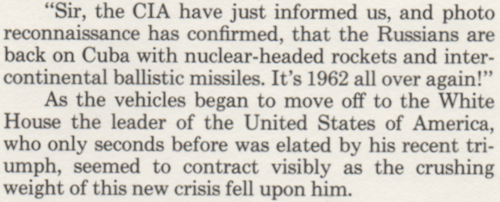
Periscope Red begins twenty-three days later. What happened to the missiles in Cuba? Why no talk of the deadly natural gas shortage? You’d think that the Ruskies blowing up supertankers would put an end to the glut that the US sought to exploit? And, really, what's the point of spending all that money on ships only to see them sink?
Here's my theory: Balls! hit bookstores in August 1979, two months before the Soviet intervention in Afghanistan. Rohmer decided that real life was far better than his Cuban Crisis Revisited idea. Bonus: All his thinking about World War III would still apply.
A parting query regarding Yasser Arafat: Am I right that Periscope Red is the first Rohmer novel to feature a real person?
And is that not the same Yuri Andropov we grew to know and love during his final fifteen months? Perhaps not, before becoming Chairman ours headed the KGB, not the Red Army. I'm betting Rohmer was just drawing upon names he knew - hence Romanov, Smirnov, Ustinov (but not Nabokov, Bulgakov or Chekhov).
Sayeth General Andropov:
Triad? Of course, 'cause, you know, it’s the sequel.
You have to remain alert if you want to catch any of Rohmer's quirks. Here are a few I spotted:
A chapter that begins: “To sum up the main points of the briefing Mr. President…”
Hyperbole: “I think it’s safe to say that the next six days will be the most crucial between the Americans and the Russians since World War II.”
Uninformed politicians: President Hansen discovers that the Chairman of the Joint Chiefs of Staff objects to the Pakistan deployment by reading about it in The New York Times (which in turn considers the story warrants no more than a small article beneath the fold).
Stupid politicians: While Hansen is certain that the Soviet Union is the only country processing the ability to sink twenty supertankers in the Atlantic, he doesn’t rule out “revolutionaries”.
Inconsistency: Is it Japanese Red Brigade or Japanese Red Army?
Forgetfulness: What do those Germans call themselves? Badd…? Badder…? Screw it, “the dreadful gang of German revolutionaries” and “the German revolutionary group” will do.
Weirdness: Much like Thomas Jefferson and Canada, Chairman Romanov is certain that taking over the Middle East will be a mere matter of marching.
Finally, we have the significance of race, blood, or in this case genetics:
Said was a Palestinian Arab. And yet he also carried an unusual genetic strain of which his blue eyes were the manifestation. It was this combination that set him apart and provided for him special initiatives. He thought as did his Arab fellows but unlike them he did not rant, rave and merely talk. He could act.Here’s Said with Captain Rashid as imagined by
True, Periscope Red lacks a protagonist, but then À rebours has no plot. Consider it an experiment. For the first time Rohmer abandons no threads. All thin, they simply run along, barely rising or falling. And while they’re not exactly tied at the end, they do touch. That is, if one forgets that Periscope Red is the sequel to Balls!
Remember how that ended?
Periscope Red begins twenty-three days later. What happened to the missiles in Cuba? Why no talk of the deadly natural gas shortage? You’d think that the Ruskies blowing up supertankers would put an end to the glut that the US sought to exploit? And, really, what's the point of spending all that money on ships only to see them sink?
Here's my theory: Balls! hit bookstores in August 1979, two months before the Soviet intervention in Afghanistan. Rohmer decided that real life was far better than his Cuban Crisis Revisited idea. Bonus: All his thinking about World War III would still apply.
A parting query regarding Yasser Arafat: Am I right that Periscope Red is the first Rohmer novel to feature a real person?
And is that not the same Yuri Andropov we grew to know and love during his final fifteen months? Perhaps not, before becoming Chairman ours headed the KGB, not the Red Army. I'm betting Rohmer was just drawing upon names he knew - hence Romanov, Smirnov, Ustinov (but not Nabokov, Bulgakov or Chekhov).
Sayeth General Andropov:
The Americans never cease to amaze me with their inability to plan ahead for this sort of crisis. They seem to be completely incapable of doing any sort of long-term planning.Yep, every Rohmer plot tells us as much.
Triad? Of course, 'cause, you know, it’s the sequel.
Monday, 7 April 2014
When you're writing a screenplay, they tell you to think about the poster. Can an audience understand it, just from that? I guess Periscope Red would make an okay movie poster. Submarines, terrorists, the White House... but you could never cast it. Because there aren't any characters. No lead, no villain, no sidekick, no love interest. No henchman, no double-agent, no dead child or disappointed father in the hero's past. No ex-wife, no chief who tells the hero to play this one by the book. No mentor, no reporter, no genius hacker. No villain's girlfriend. No nothing.
It's like some sort of bizarre exercise, like writing a novel without the letter "a."
Here's what happens in Periscope Red.
Palestinian terrorists get on a freighter with a mysterious cargo of super mines. (The Palestinians, for reasons known only to Richard Rohmer, are working for the Soviet Union, and against the interests of the Arab oil states. This isn't a plot point. It just is. They're just doing it... because. They're basically the Beagle Boys.) Meanwhile, the President of the United States decides to send troops to Pakistan. This angers the Russians. A British submarine encounters a device that blocks sonar. This means Russian submarines can get into the South Atlantic without being detected. The Russians tell the Americans to take their troops out of Pakistan. The Americans say no. The Palestinians use their super mines to blow up a lot of oil tankers. The Russians use their submarines to blow up a lot of tankers. The British submarine doesn't get sunk at first, but then it does. This means war the end.
And it's unbelievably boring. I mean, it's excruciating. Not only does it go on and on, but it has so little drive it gives you a sensation of learned helplessnes, because there's nothing building. So you can't imagine how (if ever) it could possibly end. And you realize it's not building because it's Rohmer, so there's going to be a cliffhanger instead of an ending. It's awful. It's easily his worst book yet.
Because no one does anything.
It doesn't even have any howlers about sex and natural gas.
Sure, it makes as little sense as the classic early Rohmers: Why does the plan require the Palestinians at all? Why not just have the Russian submarines sink all the tankers? And why does Yasser Arafat issue a statement about sinking some but not others? Why not all of them? Or none?
But the fun is gone.
I think there's one great line, after the President has sex on Air Force One, about the First Lady's "satisfied thighs," but nothing could make me look it up. I'm not going through that hell again.
Triad, boys?
It's like some sort of bizarre exercise, like writing a novel without the letter "a."
Here's what happens in Periscope Red.
Palestinian terrorists get on a freighter with a mysterious cargo of super mines. (The Palestinians, for reasons known only to Richard Rohmer, are working for the Soviet Union, and against the interests of the Arab oil states. This isn't a plot point. It just is. They're just doing it... because. They're basically the Beagle Boys.) Meanwhile, the President of the United States decides to send troops to Pakistan. This angers the Russians. A British submarine encounters a device that blocks sonar. This means Russian submarines can get into the South Atlantic without being detected. The Russians tell the Americans to take their troops out of Pakistan. The Americans say no. The Palestinians use their super mines to blow up a lot of oil tankers. The Russians use their submarines to blow up a lot of tankers. The British submarine doesn't get sunk at first, but then it does. This means war the end.
And it's unbelievably boring. I mean, it's excruciating. Not only does it go on and on, but it has so little drive it gives you a sensation of learned helplessnes, because there's nothing building. So you can't imagine how (if ever) it could possibly end. And you realize it's not building because it's Rohmer, so there's going to be a cliffhanger instead of an ending. It's awful. It's easily his worst book yet.
Because no one does anything.
It doesn't even have any howlers about sex and natural gas.
Sure, it makes as little sense as the classic early Rohmers: Why does the plan require the Palestinians at all? Why not just have the Russian submarines sink all the tankers? And why does Yasser Arafat issue a statement about sinking some but not others? Why not all of them? Or none?
But the fun is gone.
I think there's one great line, after the President has sex on Air Force One, about the First Lady's "satisfied thighs," but nothing could make me look it up. I'm not going through that hell again.
Triad, boys?
Sunday, 16 March 2014
So, we're finished with book #6, right?
Of the twenty-five or so remaining Rohmers, the one I most want to read is How to Write a Bestseller, because Balls! has planted an idea: Rohmer begins his books with the ending in mind, but has no clue as to how he’ll reach same. This hardly matters because every false start and each dead end contains something he wants to impart. I doubt the man has ever cut so much as a sentence in his entire career.
Balls! is the least Canadian Rohmer thus far. The novel’s hero,Sam Harris Joey Kowal Hugh Baker John Hansen Mark James, is an American. Canada doesn’t even come into play until page 163. Though White House staff advise otherwise, Albertan Peter Lougheed Lockhart, the prime minister, is a patsy, always at the ready to fly down to Washington. Hansen calls him Peter; Lockhart calls Hansen Mr. President. That the prime minister's unfounded fears of American invasion and annexation prove to be correct is a fluke, supported by the author's oddly skewed world view. In Rohmer’s geopolitical reality, Canada is in a perpetual state of threat because the Americans want our energy. The reaction of the Soviets, the United Kingdom, the Commonwealth, and the United Nations to American invasion and annexation is never considered.
A queer anti-government vein runs through Rohmer's big Balls! (his biggest novel thus far). TransState shuts off the heat in 350,000 homes before bothering to inform New York's Governor Sharpe. Company president Sam Harris is kind enough to offer advice: “The question of how to handle this from the people’s point of view – emergency measures, the National Guard, the Army, the federal government, police, traffic, telling people what to do and getting them organized – that’s your bag, sir.”
Uncle Mike talks back to the TV, demanding that Sharpe fix an hours-old crisis that is the fault entirely of private industry. Meanwhile, nephew Joey announces that he will not - will not! - take his wife and infant twins to an emergency government shelter. He gives his brilliant middle finger to the Governor, Sharpe's advice and his offer of support, then takes to the road in a dangerously overloaded station wagon. Minutes later, finding himself stuck in a supernatural snowdrift, Joey expects government rescue. It never comes. So much for the Nanny State.
I wonder whether Joey’s lack of faith in Sharpe might have something to do with the fact that Rohmer's leaders of men, businessman and politicians exclusively, are forever throwing hyperbole into hyperdrive:
The greatest tragedy in Balls! is that the Buffalo Disaster could have been avoided if only the President had chosen a career the energy industry instead of politics. Don't take my word for it - no less an expert than Petro-Canada president Bill Hooper describes the politician's off-the-cuff tanker plan as “Clever, very clever. Ingenious!”
What is that plan? Purchase and retrofit underused ships to carry natural gas.
Of course! [head slap]
The United States government will do what the private sector won’t. It will spend billions to get gas to Americans, righting a dangerous situation created by the energy companies. Lest you think that the country is descending into socialism, Vice-President James reassures: “We believe in the free enterprise system. So we’ll get out as quickly as we can.”
God Bless America.
Q: If, as Governor Sharpe states, the lives of close to a million Americans in Pennsylvania, Ohio and New York State are at risk, how is it that loss of life is limited to the City of Buffalo?
And on that note, the revised Richard Rohmer Body Count:
Of the twenty-five or so remaining Rohmers, the one I most want to read is How to Write a Bestseller, because Balls! has planted an idea: Rohmer begins his books with the ending in mind, but has no clue as to how he’ll reach same. This hardly matters because every false start and each dead end contains something he wants to impart. I doubt the man has ever cut so much as a sentence in his entire career.
Balls! is the least Canadian Rohmer thus far. The novel’s hero,
A queer anti-government vein runs through Rohmer's big Balls! (his biggest novel thus far). TransState shuts off the heat in 350,000 homes before bothering to inform New York's Governor Sharpe. Company president Sam Harris is kind enough to offer advice: “The question of how to handle this from the people’s point of view – emergency measures, the National Guard, the Army, the federal government, police, traffic, telling people what to do and getting them organized – that’s your bag, sir.”
Uncle Mike talks back to the TV, demanding that Sharpe fix an hours-old crisis that is the fault entirely of private industry. Meanwhile, nephew Joey announces that he will not - will not! - take his wife and infant twins to an emergency government shelter. He gives his brilliant middle finger to the Governor, Sharpe's advice and his offer of support, then takes to the road in a dangerously overloaded station wagon. Minutes later, finding himself stuck in a supernatural snowdrift, Joey expects government rescue. It never comes. So much for the Nanny State.
I wonder whether Joey’s lack of faith in Sharpe might have something to do with the fact that Rohmer's leaders of men, businessman and politicians exclusively, are forever throwing hyperbole into hyperdrive:
- “What we’re listening to is probably the most important decision outside a declaration of war,” says swinging bachelor Angelo Grazzi as his company shuts off supply lines.
- Governor Sharpe considers the loss of heat in 350,000 homes “the most profound crisis and emergency the country has ever seen.” He will later describe same as “the worst single disaster that has ever occurred in this country.”
- Vice-President Mark James tells the President that the country may be at “its weakest point since the Revolution.”
The greatest tragedy in Balls! is that the Buffalo Disaster could have been avoided if only the President had chosen a career the energy industry instead of politics. Don't take my word for it - no less an expert than Petro-Canada president Bill Hooper describes the politician's off-the-cuff tanker plan as “Clever, very clever. Ingenious!”
What is that plan? Purchase and retrofit underused ships to carry natural gas.
Of course! [head slap]
The United States government will do what the private sector won’t. It will spend billions to get gas to Americans, righting a dangerous situation created by the energy companies. Lest you think that the country is descending into socialism, Vice-President James reassures: “We believe in the free enterprise system. So we’ll get out as quickly as we can.”
God Bless America.
Q: If, as Governor Sharpe states, the lives of close to a million Americans in Pennsylvania, Ohio and New York State are at risk, how is it that loss of life is limited to the City of Buffalo?
And on that note, the revised Richard Rohmer Body Count:
Ultimatum: 1
Exxoneration: 200 (approx.)
Exodus/UK: 18*
Separation: 5
Separation Two: 1**
Balls!: 19,228***
* 17 according to Separation;18 according to Separation Two.
** does not include deaths first described in Separation, which is “the same book, yet different.”
*** may or may not include the 40th President of the United States.
Thursday, 13 March 2014
Those last two posts were great - what more can I add about this ludicrously disjointed book?
I would say spoiler alert here, but I'm not convinced anything we've blogged has led a single person to try reading any of these books. Ah well, dear readers - we are doing this for your benefit and no one said it would be easy.
So what do have here: a main character (Sam Harris) who turns out to be just in the wrong job at the wrong time and his story ends somewhere in the middle of the book. An entire social-realist interlude with the extended Kowal family who rather abruptly freeze to death after their story is abandoned in a snow drift. Why are they in the story at all? So surviving father Joe can show up and shoot that weasel Schmit, that's why. Schmit, by virtue of the fact there isn't another one, is the book's de facto villain. How bad is he? He smokes in the presence of non-main-character Sam Harris, annoying him to no end.
And so that must mean that President Barker is the book's main character. He gives it a go, but ends up dying of a heart attack around the middle of the book as well. So I guess he and his virile successor, President Hansen, share main character duties. Unless you count globe-trotting, deal-making vice-president James.
But let's do this in order:
1. Brian - I want to second your suspicion that brilliant young lawyer Joey Kowal is a moron: faced with crippling cold, a family to save and a half a tank of gas to do it with, he takes a stand about going to a shelter - like that would likely be the worst possible choice he could make.
2. Did they have to cut off the gas completely? Couldn't they have done rotating cuts in the region?
3. Once President Hansen comes up with his brilliant secret plan to insure there will never be another Buffalo, what is the first thing he has the VP do? Why, fly north to Melville Island to "get a look at" the energy installation there. Why? Well if it was good enough for President Blank in Ultimatum, it's good enough for VP James. Once again we are subjected to another high-ranking US official flying to Northern Canada in the middle of a crisis so we can get pages and pages of descriptions of how energy is being processed. And there isn't a single bit of information he couldn't have got from the blueprints he asks Hooper for.
R-RATED ROHMER
So this marks yet another step forward for Rohmer allowing actual scenes of romance, seduction and L-U-V to intrude on the main energy story. As outlandos d'amour VP James and his sidekick Katz fly around the world trying to finish a business deal (there - the last 100 pages summarized for your convenience), we get to see them engaged in a little cat-and-mouse game with the US Ambassador and her secretary. Of course it's ridiculous - James and Ambassador Hunt meet, fall in love, have a torrid affair and agree to marry - in about 24 hours. "But - she's a democrat!" teases President Hansen as the two engage in good-natured guy talk. James Carville and Mary Matalin they ain't, but I'll try and be kind here and say at least when Rohmer decides to write relationship stuff, no one talks about how many trillion cubic feet of natural gas the US will need to make sure there isn't another Buffalo.
And for the second time, a scene caused me to laugh out loud on the bus: VP James is in London, and calls President Hansen to give him an update: "The President sounded mellow and happy despite the hour. James didn't know, although he might have guessed, that John Hansen had just been through one of those delicious wake-ups that his young wife was so good at.".
"although he might have guessed"???? What? The two barely knew each other before they ended up becoming President and Vice-President. It's 7:15 in the morning - is that really the first thing that would have crossed his mind?
I would say spoiler alert here, but I'm not convinced anything we've blogged has led a single person to try reading any of these books. Ah well, dear readers - we are doing this for your benefit and no one said it would be easy.
So what do have here: a main character (Sam Harris) who turns out to be just in the wrong job at the wrong time and his story ends somewhere in the middle of the book. An entire social-realist interlude with the extended Kowal family who rather abruptly freeze to death after their story is abandoned in a snow drift. Why are they in the story at all? So surviving father Joe can show up and shoot that weasel Schmit, that's why. Schmit, by virtue of the fact there isn't another one, is the book's de facto villain. How bad is he? He smokes in the presence of non-main-character Sam Harris, annoying him to no end.
And so that must mean that President Barker is the book's main character. He gives it a go, but ends up dying of a heart attack around the middle of the book as well. So I guess he and his virile successor, President Hansen, share main character duties. Unless you count globe-trotting, deal-making vice-president James.
But let's do this in order:
1. Brian - I want to second your suspicion that brilliant young lawyer Joey Kowal is a moron: faced with crippling cold, a family to save and a half a tank of gas to do it with, he takes a stand about going to a shelter - like that would likely be the worst possible choice he could make.
2. Did they have to cut off the gas completely? Couldn't they have done rotating cuts in the region?
3. Once President Hansen comes up with his brilliant secret plan to insure there will never be another Buffalo, what is the first thing he has the VP do? Why, fly north to Melville Island to "get a look at" the energy installation there. Why? Well if it was good enough for President Blank in Ultimatum, it's good enough for VP James. Once again we are subjected to another high-ranking US official flying to Northern Canada in the middle of a crisis so we can get pages and pages of descriptions of how energy is being processed. And there isn't a single bit of information he couldn't have got from the blueprints he asks Hooper for.
R-RATED ROHMER
So this marks yet another step forward for Rohmer allowing actual scenes of romance, seduction and L-U-V to intrude on the main energy story. As outlandos d'amour VP James and his sidekick Katz fly around the world trying to finish a business deal (there - the last 100 pages summarized for your convenience), we get to see them engaged in a little cat-and-mouse game with the US Ambassador and her secretary. Of course it's ridiculous - James and Ambassador Hunt meet, fall in love, have a torrid affair and agree to marry - in about 24 hours. "But - she's a democrat!" teases President Hansen as the two engage in good-natured guy talk. James Carville and Mary Matalin they ain't, but I'll try and be kind here and say at least when Rohmer decides to write relationship stuff, no one talks about how many trillion cubic feet of natural gas the US will need to make sure there isn't another Buffalo.
And for the second time, a scene caused me to laugh out loud on the bus: VP James is in London, and calls President Hansen to give him an update: "The President sounded mellow and happy despite the hour. James didn't know, although he might have guessed, that John Hansen had just been through one of those delicious wake-ups that his young wife was so good at.".
"although he might have guessed"???? What? The two barely knew each other before they ended up becoming President and Vice-President. It's 7:15 in the morning - is that really the first thing that would have crossed his mind?
Wednesday, 12 March 2014
Last night I read another sixty pages of Balls! Tough going, it was nowhere near as exciting as Joey Kowal’s lengthy Ponce de León-like quest for extension cords.
Having reached page 239, I have a horrible feeling that I’ve read the last of the Kowal clan. Still, I hold out hope. After all, is there not something magical in their journey? Consider Joey’s station wagon, which can burrow “like a huge mole”. What of the enchanted snowdrift that envelopes the Kowals, protecting them from the horrors and cold of the outside world? How long before the White Witch makes an appearance? How about Mr and Mrs Beaver? Tumnus is sure to alert Aslan to their plight.
I don’t mean to go all Edmund here, but I’m grappling with a loss of faith. Pray forgive me for thinking Harvard Law School graduate Joey Kowal is a dim bulb.
Evidence:
I lived in Toronto for four years, and it’s just shy of six since I moved to St Marys, yet I’ve still not visited Buffalo (a mere 2 ½ hours south-east). I now know to wait until spring. Here are other things I’ve learned about the city from Balls!:
Here are a few other things I've learned through Balls!:
Just over one hundred pages remain.
Having reached page 239, I have a horrible feeling that I’ve read the last of the Kowal clan. Still, I hold out hope. After all, is there not something magical in their journey? Consider Joey’s station wagon, which can burrow “like a huge mole”. What of the enchanted snowdrift that envelopes the Kowals, protecting them from the horrors and cold of the outside world? How long before the White Witch makes an appearance? How about Mr and Mrs Beaver? Tumnus is sure to alert Aslan to their plight.
I don’t mean to go all Edmund here, but I’m grappling with a loss of faith. Pray forgive me for thinking Harvard Law School graduate Joey Kowal is a dim bulb.
Evidence:
- Though Joey and his kin are secure, if uncomfortable, in his parents’ duplex - the one they bought in 1950 (p.69), the one they’d decided to buy (p.70), the one with the price that was right (p. 70), the one they chose to buy (p. 70) – he believes that the best course of action is to leave.
- Faced with the worst winter storm in Buffalo’s history, he decides to take to the road in an overloaded station wagon carrying five adults and two infants (intending to pick up Papa Joe along the way).
- Though there is “gasoline rationing in Buffalo and throughout the United States”, Joey thinks he’ll be just fine with half a tank.
- Lawyer Joey decides on a southern route to Florida (1775 km), even though Canada - which is untouched by the TransState Gas Distribution Corporation cut-off is just a couple of kilometres to the west.
I lived in Toronto for four years, and it’s just shy of six since I moved to St Marys, yet I’ve still not visited Buffalo (a mere 2 ½ hours south-east). I now know to wait until spring. Here are other things I’ve learned about the city from Balls!:
- All buildings in Buffalo – be they detached Victorian Italianate, mid-20th-century condo, high school or government edifice - are heated by natural gas. No oil. No electricity, either.
- Not one residence in Buffalo features a fireplace. Houses have no insulation and paper thin exterior walls.
- Water freezes more quickly in Buffalo than it does in the rest of the world.
- Buffalo’s electrical grid is second to none.
Here are a few other things I've learned through Balls!:
- Should disaster befall an area between Election Day and Inauguration Day it falls on the President-Elect to declare a state of emergency.
- The United States National Weather Service provides thirty-day forecasts.
- One thing more boring than reading a travel itinerary is an account of how same came together.
- Smoking is bad.
- Conservationists are emotional.
- Sam Richardson is black.
Just over one hundred pages remain.
Saturday, 8 March 2014
I devoured the last of Richard Rohmer's Balls! in one sitting last night. And with that fresh in my mind -- and the horror of the image fresh in yours -- here are my thoughts:
Sir Michael Wilson and Qasim Khan (the man with hooded eyes; The Cobra)
On page 12 of Balls! we are introduced to Michael Wilson, ship broker, and Qasim Khan, ship haver. Qasim has heard a rumor that pretty soon someone's going to be needing tankers in the worst way, and Qasim wants to make sure Wilson brokers his first. Qasim threatens to blackmail Wilson if he doesn't get the message and do what he's told when the time comes.
This never comes up again.
Does Qasim know Buffalo's about to get a President-killing snowstorm that will turn America from a nation of many needs, abilities, gifts, dreams etc., into a entity only interested in buying tankers?
If so, how does he know? Does he own a weather machine? Would a weather machine be more valuable than a boat? If you owned a weather machine, would you use it to attack Buffalo, in order to sell more boats?
Sam Harris, Oil Man
Vanishes, with a golden parachute, on page 175, never to be seen again.
I think the disappearance of Qasim Khan is just one of those things that makes Rohmer Rohmer. It's like Glenn Gould's grunting. Abandoned plot threads are part of the fun. Like getting the same information a half dozen times, or the inevitable appearance of the Mackenzie Delta. (Page 226)
I think the disappearance of Sam Harris -- oil genius/sex machine -- and the appearance of George Stratton -- oil genius/sex machine -- is something else entirely. It's evidence of a heavy (and hacky) rewrite.
I think the whole book is about Sam Harris, president of TransWhathamacallit, and "George Stratton", Vice President of the United States, is his Tyler Durden. Same guy, different name. And the result of a really late-in-the-game overhaul.
Here's a story that kinda makes sense: Sam Harris runs an oil company. They fuck up (or get attacked with a weather machine) and kill almost everyone in Buffalo, NY. Sam Harris decides that will never happen again, and sets out to buy thousands of oil tankers and convert them to LNG tankers. He does, the end. (Yes, that's a lame ending. But all Rohmer business deals have the same lame ending. This guy flies around asking people to sell him things. They do. Tah-da!)
Here's a story that's a mess: Sam Harris runs an oil company. It screws up, and everyone in Buffalo drives their car into the snow. Sam Harris feels so bad about it, his bosses fire him, because, oh yeah, they also just found out his mother was Jewish. Sam Harris is never seen again. Meanwhile, the President dies, the new President picks s a completely different natural gas-obsessive, Senator George Stratton, to be Vice President. The President has a mission for George: America (the country) is going to start buying natural gas by the trillions of cubic feet and America (the country) is going to buy thousands of ships to move it. So George does just that. Because he and the President are both Republicans (and so is the Senate and so's Congress, we're told) and they love free enterprise. A hasty note, very late in the game -- "Oh, yeah, and we'll get the oil companies involved."
It's not just bad storytelling. It's nonsense.
I think Rohmer wrote another businessman's day dream -- "A guy should buy all those oil tankers and turn them into LNG tankers" and someone (Editor X) told Rohmer thrillers need Presidents.
And maybe some kind of conspiracy? Or at least a double cross? Or even a setback? Anything? So it's not just:
Hi, will you sell me those tankers?
Yes, I will.
Thank you.
Thank you.
How about a really ugly/beautiful PLO assassin? Or the most careless hit man in Calgary? Maybe Balls II?
As Dudley Moore says to Peter Cook, "The main trouble with your story is that it lacks everything."
Air Force One
It was nice to see that Rohmer had improved on Ultimatum by having the President travel by Marine One (which actually exists) rather than his personal Navy helicopter that doesn't. Also, putting Air Force One at Andrews AFB -- where it is -- rather than Dulles -- where it isn't. But Rohmer has over-corrected (Glenn Gould: "Hguhnah-uh--uh-uh") and now all airplanes are more or less "Air Force Ones" and he goes out of his way for various cyphers to tell each other the Vice President will be taking the 707 Air Force One -- with its markings painted over! -- and not the 747 Air Force One, or any of the other Air Force Ones that are lying around.
When the President is on a plane, it's designated Air Force One. When the President isn't on it, it's designated something else. He also has a plane called Air Force One. All the other planes aren't Air Force Ones. They're just planes. Unless the President gets on them. Who cares, of course? But it sounds dopey when Rohmer goes to crazy lengths to get it wrong.
I'll be driving my private car. It's the 3:15 Greyhound from Amarillo to Dallas.
You'd better have it painted over.
No need. It's not a bus. I just call it that.
But not in this case?
Right. Today it's just my car.
During the last 100 pages of Balls! -- when it became clear that there weren't any twists to the business deal coming, and when it looked like we were setting up to do Ultimatum again, with Canada holding out on the juice, and when he complained about environmentalists again -- for the first time, and I know I'm being childish, I really sort of hated Richard Rohmer.
Sir Michael Wilson and Qasim Khan (the man with hooded eyes; The Cobra)
On page 12 of Balls! we are introduced to Michael Wilson, ship broker, and Qasim Khan, ship haver. Qasim has heard a rumor that pretty soon someone's going to be needing tankers in the worst way, and Qasim wants to make sure Wilson brokers his first. Qasim threatens to blackmail Wilson if he doesn't get the message and do what he's told when the time comes.
This never comes up again.
Does Qasim know Buffalo's about to get a President-killing snowstorm that will turn America from a nation of many needs, abilities, gifts, dreams etc., into a entity only interested in buying tankers?
If so, how does he know? Does he own a weather machine? Would a weather machine be more valuable than a boat? If you owned a weather machine, would you use it to attack Buffalo, in order to sell more boats?
Sam Harris, Oil Man
Vanishes, with a golden parachute, on page 175, never to be seen again.
I think the disappearance of Qasim Khan is just one of those things that makes Rohmer Rohmer. It's like Glenn Gould's grunting. Abandoned plot threads are part of the fun. Like getting the same information a half dozen times, or the inevitable appearance of the Mackenzie Delta. (Page 226)
I think the disappearance of Sam Harris -- oil genius/sex machine -- and the appearance of George Stratton -- oil genius/sex machine -- is something else entirely. It's evidence of a heavy (and hacky) rewrite.
I think the whole book is about Sam Harris, president of TransWhathamacallit, and "George Stratton", Vice President of the United States, is his Tyler Durden. Same guy, different name. And the result of a really late-in-the-game overhaul.
Here's a story that kinda makes sense: Sam Harris runs an oil company. They fuck up (or get attacked with a weather machine) and kill almost everyone in Buffalo, NY. Sam Harris decides that will never happen again, and sets out to buy thousands of oil tankers and convert them to LNG tankers. He does, the end. (Yes, that's a lame ending. But all Rohmer business deals have the same lame ending. This guy flies around asking people to sell him things. They do. Tah-da!)
Here's a story that's a mess: Sam Harris runs an oil company. It screws up, and everyone in Buffalo drives their car into the snow. Sam Harris feels so bad about it, his bosses fire him, because, oh yeah, they also just found out his mother was Jewish. Sam Harris is never seen again. Meanwhile, the President dies, the new President picks s a completely different natural gas-obsessive, Senator George Stratton, to be Vice President. The President has a mission for George: America (the country) is going to start buying natural gas by the trillions of cubic feet and America (the country) is going to buy thousands of ships to move it. So George does just that. Because he and the President are both Republicans (and so is the Senate and so's Congress, we're told) and they love free enterprise. A hasty note, very late in the game -- "Oh, yeah, and we'll get the oil companies involved."
It's not just bad storytelling. It's nonsense.
I think Rohmer wrote another businessman's day dream -- "A guy should buy all those oil tankers and turn them into LNG tankers" and someone (Editor X) told Rohmer thrillers need Presidents.
And maybe some kind of conspiracy? Or at least a double cross? Or even a setback? Anything? So it's not just:
Hi, will you sell me those tankers?
Yes, I will.
Thank you.
Thank you.
How about a really ugly/beautiful PLO assassin? Or the most careless hit man in Calgary? Maybe Balls II?
As Dudley Moore says to Peter Cook, "The main trouble with your story is that it lacks everything."
Air Force One
It was nice to see that Rohmer had improved on Ultimatum by having the President travel by Marine One (which actually exists) rather than his personal Navy helicopter that doesn't. Also, putting Air Force One at Andrews AFB -- where it is -- rather than Dulles -- where it isn't. But Rohmer has over-corrected (Glenn Gould: "Hguhnah-uh--uh-uh") and now all airplanes are more or less "Air Force Ones" and he goes out of his way for various cyphers to tell each other the Vice President will be taking the 707 Air Force One -- with its markings painted over! -- and not the 747 Air Force One, or any of the other Air Force Ones that are lying around.
When the President is on a plane, it's designated Air Force One. When the President isn't on it, it's designated something else. He also has a plane called Air Force One. All the other planes aren't Air Force Ones. They're just planes. Unless the President gets on them. Who cares, of course? But it sounds dopey when Rohmer goes to crazy lengths to get it wrong.
I'll be driving my private car. It's the 3:15 Greyhound from Amarillo to Dallas.
You'd better have it painted over.
No need. It's not a bus. I just call it that.
But not in this case?
Right. Today it's just my car.
During the last 100 pages of Balls! -- when it became clear that there weren't any twists to the business deal coming, and when it looked like we were setting up to do Ultimatum again, with Canada holding out on the juice, and when he complained about environmentalists again -- for the first time, and I know I'm being childish, I really sort of hated Richard Rohmer.
Monday, 17 February 2014
Next is BALLS! right? I want BALLS! BALLS! It's gotta be BALLS! Please say next we grapple with BALLS!
Or let's have a vote. In the spirit of Rohmer Leadership, I've already decided which way I'm voting, but for reasons that are different each time I'm not telling anyone until the very last possible...
(but just between you and me, it's BALLS!)
My copy of BALLS! has a big enormous tanker full of liquified natural gas on the cover. Could it be bringing LNG from the MacKenzie Delta? We won't know until we read BALLS!
Or let's have a vote. In the spirit of Rohmer Leadership, I've already decided which way I'm voting, but for reasons that are different each time I'm not telling anyone until the very last possible...
(but just between you and me, it's BALLS!)
My copy of BALLS! has a big enormous tanker full of liquified natural gas on the cover. Could it be bringing LNG from the MacKenzie Delta? We won't know until we read BALLS!
Thursday, 13 February 2014
Okay - I assume we're all far in enough into Separation that I can make this comment. Like Linus when he had the school election wrapped up and just couldn't stop himself from talking about the Great Pumpkin, Rohmer cannot stop himself from talking about energy in the North - even when there is NO REASON whatsoever to do so.
Right after Michael Lucas is told by the PM things he already knows ("Okay, Michael, now that you're the English Deputy Prime Minister representing English Canada and you're going to monitor everything I'm doing"), we get 7 pages - 7 full pages in a short novel - of his backstory as Energy Minister, including the requisites mentions of the Mackenzie Delta, The Prudhoe Bay -to-Valdez pipeline, how much natural gas was found in Prudhoe Bay (7 trillion cubic feet!), OPEC supply levels sent to Canada (900,000 barrels per day!) and endless legal agreements Lucas had worked out in his outstanding career thus far. Page after page that not only has nothing to do with the story, but actually interrupts a pivotal scene where we are going to first meet the Quebec premier and get his side of the story. It's a tense moment, but instead of first confrontation between English and French Canada, we have to take a trip to the North and hear about energy.
I will admit here that halfway through it, I actually looked ahead in the book and seeing there were still pages of oil and natural gas exposition to go, I laughed out loud on the Metro. I have to wonder if anyone looked at the cover of the book and wondered if it was supposed to be funny.
Right after Michael Lucas is told by the PM things he already knows ("Okay, Michael, now that you're the English Deputy Prime Minister representing English Canada and you're going to monitor everything I'm doing"), we get 7 pages - 7 full pages in a short novel - of his backstory as Energy Minister, including the requisites mentions of the Mackenzie Delta, The Prudhoe Bay -to-Valdez pipeline, how much natural gas was found in Prudhoe Bay (7 trillion cubic feet!), OPEC supply levels sent to Canada (900,000 barrels per day!) and endless legal agreements Lucas had worked out in his outstanding career thus far. Page after page that not only has nothing to do with the story, but actually interrupts a pivotal scene where we are going to first meet the Quebec premier and get his side of the story. It's a tense moment, but instead of first confrontation between English and French Canada, we have to take a trip to the North and hear about energy.
I will admit here that halfway through it, I actually looked ahead in the book and seeing there were still pages of oil and natural gas exposition to go, I laughed out loud on the Metro. I have to wonder if anyone looked at the cover of the book and wondered if it was supposed to be funny.
Monday, 10 February 2014
I'm with you both. Exodus/UK is a much better novel than its predecessors, but it shook my faith in the author. Prior to this novel I was all too ready to accept the facts and figures he was apt to throw around. Does it really make economic sense to use tanker jets in transporting natural gas from the Arctic to Chicago? Seems not, but then I'm taken aback whenever the gas light goes on in my Jeep Liberty.
Hey, Richard Rohmer is a businessman and, according to jacket copy a "member of various boards… the President of the Mid-Canada Development Foundation Inc." You'll understand why I placed my trust in the Major-General, Colonel Pierre Thomas de Gaspé and the captains of industry.
But with Exodus/UK I found myself on familiar foreign territory. I've held a fistful of tickets to England in my day and I've moved my stuff - signed Exxoneration included - some fairly long distances: Montreal to Vancouver, Vancouver to Toronto, Toronto to Vancouver, Vancouver to Ottawa and Ottawa to St. Marys (resting place of Arthur Meighen, one of Joseph Roussel's predecessors). Believe me, the costs of these things haunt.
So I ask myself how much money it would take to relocate six million Britons and at a least some of their crap to Canada, the United States, Australia and New Zealand (1975 pop.: 3.09 million)? Back in 1975, there's no way it could've been done for less than C$5000 per person ($20,315 today)… which amounts to C$30-billion ($121.8 billion today)… which means everyone is much better off just staying at home and watching Top of the Pops. I'll add that the economic devastation wrought by the withdrawal of Saudi investments would worsen greatly with two or so million empty homes being suddenly put up for sale. Good Lord, the Oxfam shops would be overflowing.
Do you dare? I do.
I dare call conspiracy!
Is it not curious that Jeremy Sands first mentions the idea of mass British emigration not six hours into the crisis? Is it not odd that he already has figures in hand that indicate two million would seek to emigrate to Canada in just such a crisis?
As with The Turn of the Screw, I suggest that things are not quite as they seem. I suggest that all is part of a plot to rid the United Kingdom of trade unionists. I suggest that crop-wielding dominatrix Jenny Powis is a government plant who was intended to incite. I question how it is that in the days before social media a crowd of 10,000 was able to gather at Trafalgar Square within two hours of the economic crisis made public.
Finally, I suggest that Prime Minister Jeremy Sands be charged in causing the death of Major Anthony Andrews of the Coldstream Guards, "whose body lay covered with a white sheet in Trafalgar Square, amid the feverish efforts to tend to the injuries of those who had struck him down." Like the car set ablaze during the 2010 Toronto Summit protests, he was sacrificed by the state.
Hey, Richard Rohmer is a businessman and, according to jacket copy a "member of various boards… the President of the Mid-Canada Development Foundation Inc." You'll understand why I placed my trust in the Major-General, Colonel Pierre Thomas de Gaspé and the captains of industry.
 |
| London, July 1974 (The year of the Diamond Dogs). |
So I ask myself how much money it would take to relocate six million Britons and at a least some of their crap to Canada, the United States, Australia and New Zealand (1975 pop.: 3.09 million)? Back in 1975, there's no way it could've been done for less than C$5000 per person ($20,315 today)… which amounts to C$30-billion ($121.8 billion today)… which means everyone is much better off just staying at home and watching Top of the Pops. I'll add that the economic devastation wrought by the withdrawal of Saudi investments would worsen greatly with two or so million empty homes being suddenly put up for sale. Good Lord, the Oxfam shops would be overflowing.
Do you dare? I do.
I dare call conspiracy!
Is it not curious that Jeremy Sands first mentions the idea of mass British emigration not six hours into the crisis? Is it not odd that he already has figures in hand that indicate two million would seek to emigrate to Canada in just such a crisis?
As with The Turn of the Screw, I suggest that things are not quite as they seem. I suggest that all is part of a plot to rid the United Kingdom of trade unionists. I suggest that crop-wielding dominatrix Jenny Powis is a government plant who was intended to incite. I question how it is that in the days before social media a crowd of 10,000 was able to gather at Trafalgar Square within two hours of the economic crisis made public.
Finally, I suggest that Prime Minister Jeremy Sands be charged in causing the death of Major Anthony Andrews of the Coldstream Guards, "whose body lay covered with a white sheet in Trafalgar Square, amid the feverish efforts to tend to the injuries of those who had struck him down." Like the car set ablaze during the 2010 Toronto Summit protests, he was sacrificed by the state.
Exodus / UK, a book I've read, is head-and-shoulders better than ULTIMATUM and EXXONERATION. While they were thoughts -- What if America wanted Canada's natural gas? Well, what if Canada wanted America's oil? -- it's very nearly a novel. Not quite, but almost. At least it has a second and a third stage to the businessman's day dream: Saudi Arabia cuts off the United Kingdom's oil AND THEN the Prime Minister asks Canada to take millions of refugees AND THEN Quebec secedes. (And then the Americans say they'll help England drill in the North Sea, but only if no trade unions are involved. Also, stewardess, are there any more golf magazines? All I've got is Macleans. What kind of first class is this?)
Of course, the premise makes no sense at all, and characters spend a fair amount of time defending it to each other: "But why would the Saudis deliberately tank an economy that buys their oil?" (They're mad at England for selling Israel weapons.) "Okay, then why don't they cut off America's oil?" (They really need America's weapons.) "Who's going to pay to take care of all the refugees once they get to Canada?" (The UK.) "But then wouldn't it be cheaper to keep them where they are? Even if it only meant not buying all those plane tickets?" (Unanswered.) "If the UK can get all the oil it needs from the North Sea -- in 18 months! -- once the unions get out of the way, why do all the immigrants have to immigrate at all? (Unanswered. Stewardess?)
Like they say in sketch comedy, "buy the premise, buy the bit."
Once that's all rolling, Rohmer adds some features unavailable on earlier models: At least three characters with flaws and two professional-grade action sequences, a plane crash and a riot. The plane crash doesn't actually affect the plot one way or another -- the PM wants to get to a meeting, his plane crashes, they rescue him, he goes to the meeting -- but it's still action.
Rohmer still has no practical sense of how a "ticking clock" functions in a thriller, but at least you get the sense that he gets the sense that he's missing something.
Rohmer Gets Off a Zinger:
Carter-Smith was from a well-to-do, upper-class family and had discovered socialism on his way through university. He was the worst kind of know-it-all radical. With his family fortune behind him, he was ready to redistribute everybody else's money among the workers. "Rather like a recent Canadian Prime Minister," Sands had been heard to comment.
Rohmer Makes a Cameo:
The Prime Minister agreed. "Excellent idea. That plan was put forward by some lawyer from Toronto wasn't it? I've forgotten his name. Now Mr. Philips, the finance question.
People Tell People Things They Already Know:
As you know, Prime Minister, the Bank of England, with the approval of the Cabinet, has borrowed in the last two years twelve billion pounds...
As you know, the United Kingdom is in economic collapse...
You know, Gaston, we're dealing with the lives of people, men, women and children...
Madam Secretary, you know very well that our relationship with Great Britain is on a completely different footing...
In recent years, especially after the October War of 1973, when the OPEC countries quadrupled our prices within a year -- we have found ourselves with surplus revenue in our hands, in a scale of billions upon billions. All this you know.
The emigration matter is very important to him as you know...
As you know, I'm the Chancellor.
You know, you're asking the United States to make enormous commitments...
You know, you people are asking for a lot...
... the National Assembly having unanimously passed their secession resolution of which you are all aware...
As I said to you when we talked earlier this week...
He's already on his way, as you know.
As you know, it was as up as high as 10 per cent in late 1975.
Things Secretary of State Jessica Swift is:
tall
trim
slinky
elegant
attractive
articulate
attractive
beautiful
superior
attractive
superlative
"beautiful, beautiful"
Mentions of the Mackenzie Valley, Although it Has Nothing to Do with the Story: 4
Drawings of aircraft: 7
Of air routes: 2
Gentlemen, your thoughts?
Of course, the premise makes no sense at all, and characters spend a fair amount of time defending it to each other: "But why would the Saudis deliberately tank an economy that buys their oil?" (They're mad at England for selling Israel weapons.) "Okay, then why don't they cut off America's oil?" (They really need America's weapons.) "Who's going to pay to take care of all the refugees once they get to Canada?" (The UK.) "But then wouldn't it be cheaper to keep them where they are? Even if it only meant not buying all those plane tickets?" (Unanswered.) "If the UK can get all the oil it needs from the North Sea -- in 18 months! -- once the unions get out of the way, why do all the immigrants have to immigrate at all? (Unanswered. Stewardess?)
Like they say in sketch comedy, "buy the premise, buy the bit."
Once that's all rolling, Rohmer adds some features unavailable on earlier models: At least three characters with flaws and two professional-grade action sequences, a plane crash and a riot. The plane crash doesn't actually affect the plot one way or another -- the PM wants to get to a meeting, his plane crashes, they rescue him, he goes to the meeting -- but it's still action.
Rohmer still has no practical sense of how a "ticking clock" functions in a thriller, but at least you get the sense that he gets the sense that he's missing something.
Rohmer Gets Off a Zinger:
Carter-Smith was from a well-to-do, upper-class family and had discovered socialism on his way through university. He was the worst kind of know-it-all radical. With his family fortune behind him, he was ready to redistribute everybody else's money among the workers. "Rather like a recent Canadian Prime Minister," Sands had been heard to comment.
Rohmer Makes a Cameo:
The Prime Minister agreed. "Excellent idea. That plan was put forward by some lawyer from Toronto wasn't it? I've forgotten his name. Now Mr. Philips, the finance question.
People Tell People Things They Already Know:
As you know, Prime Minister, the Bank of England, with the approval of the Cabinet, has borrowed in the last two years twelve billion pounds...
As you know, the United Kingdom is in economic collapse...
You know, Gaston, we're dealing with the lives of people, men, women and children...
Madam Secretary, you know very well that our relationship with Great Britain is on a completely different footing...
In recent years, especially after the October War of 1973, when the OPEC countries quadrupled our prices within a year -- we have found ourselves with surplus revenue in our hands, in a scale of billions upon billions. All this you know.
The emigration matter is very important to him as you know...
As you know, I'm the Chancellor.
You know, you're asking the United States to make enormous commitments...
You know, you people are asking for a lot...
... the National Assembly having unanimously passed their secession resolution of which you are all aware...
As I said to you when we talked earlier this week...
He's already on his way, as you know.
As you know, it was as up as high as 10 per cent in late 1975.
Things Secretary of State Jessica Swift is:
tall
trim
slinky
elegant
attractive
articulate
attractive
beautiful
superior
attractive
superlative
"beautiful, beautiful"
Mentions of the Mackenzie Valley, Although it Has Nothing to Do with the Story: 4
Drawings of aircraft: 7
Of air routes: 2
Gentlemen, your thoughts?
Sunday, 2 February 2014
I had a thought: We should keep a running tally of Rohmerisms. (I know, this means going back. But maybe not.) Number and type of useless illustrations and maps. (Why, there's London! Right there in England!) Uses of the phrase "as you know." Number of meetings, times number of participants; estimated amount of danish consumed based on .8 danishes per person. Typos. Pages before first mention of natural gas, islands in arctic Canada that might contain same. Speaking parts for women, total number of words spoken by women, descriptions of woman as either "pretty" or "little."
I don't want to panic anyone, but as you know, two books a month, we're never going to reach our goal. He said. The atmosphere was tense.
I don't want to panic anyone, but as you know, two books a month, we're never going to reach our goal. He said. The atmosphere was tense.
Sunday, 19 January 2014
The new Tom Clancy / Jack Ryan movie came out Friday and died like a dog. It looked pretty familiar. I have to admit the only Tom Clancy book I've ever read was one of the non-fiction ones, about submarines, and I'm pretty sure there were actual submarines that had fewer people working on them than worked to produce a book "by" Tom Clancy from that period.
So I wonder if the dialogue in his fiction is as... what's the opposite of lifelike? Expressionistic? ... as Rohmer's.
I know what you mean about feeling like the first couple of chapters of EXXONORATION undid the last couple of chapters of ULTIMATUM. There's a funny moment in one of the Scream movies where someone lays out the laws of sequels, and one involves creating a new back story -- that happens before the first movie -- and ruins it. This is kind of that, right? Or maybe it's closer to a type of classic cliffhanger escape, where the next episode reveals that although the car DID go over the cliff, what you didn't see was that the hero got out just in time.
I was working at a studio that used to be Republic, and had all the titles of their old serials on tiles in the cement. I was curious, so I bought one on VHS -- Zorro's Black Whip -- and watched about 20 chapters in a row. (Hey binge watching!) They got out of every cliffhanger by reshooting the ending and making it slightly different. Of course, if you were seeing it in a theatre the next week, you'd have to trust them, that you had just remembered it wrong.
I wonder if people thought they were losing their minds?
Anyway, yes, Rohmer forgot to mention that the Canadian Armed Forces had been mobilised to repel history's greatest superpower by getting to the Toronto airport first and hiding at the arrival gate.
(I'm perfectly willing to go along for the ride, by the way -- okay, sure, America is going to invade Canada to get our natural gas -- but I feel like it would be more realistic if America just announced there was a crisis in Canada, and took over the government to restore stability. Temporarily, you know? At the invitation of a coalition of concerned nations, and/or the Frums. Then you wouldn't need to take the whole country. Just Parliament.)
And now we get to meet Pierre Thomas de Gaspe, the Least Interesting Man in the World. And we get to hear about the President's adviser "Irving Wolf" and his nose, again, not once but twice.
My favourite Rohmer line so far:
"Even though I've known you for years, Pierre, I had no idea you were involved in the military..."
My second favourite:
"The atmosphere in the Oval Office of the White House was tense."
Brian: Why didn't John Glassco ever write a book called Zorro's Black Whip?
So I wonder if the dialogue in his fiction is as... what's the opposite of lifelike? Expressionistic? ... as Rohmer's.
I know what you mean about feeling like the first couple of chapters of EXXONORATION undid the last couple of chapters of ULTIMATUM. There's a funny moment in one of the Scream movies where someone lays out the laws of sequels, and one involves creating a new back story -- that happens before the first movie -- and ruins it. This is kind of that, right? Or maybe it's closer to a type of classic cliffhanger escape, where the next episode reveals that although the car DID go over the cliff, what you didn't see was that the hero got out just in time.
I was working at a studio that used to be Republic, and had all the titles of their old serials on tiles in the cement. I was curious, so I bought one on VHS -- Zorro's Black Whip -- and watched about 20 chapters in a row. (Hey binge watching!) They got out of every cliffhanger by reshooting the ending and making it slightly different. Of course, if you were seeing it in a theatre the next week, you'd have to trust them, that you had just remembered it wrong.
I wonder if people thought they were losing their minds?
Anyway, yes, Rohmer forgot to mention that the Canadian Armed Forces had been mobilised to repel history's greatest superpower by getting to the Toronto airport first and hiding at the arrival gate.
(I'm perfectly willing to go along for the ride, by the way -- okay, sure, America is going to invade Canada to get our natural gas -- but I feel like it would be more realistic if America just announced there was a crisis in Canada, and took over the government to restore stability. Temporarily, you know? At the invitation of a coalition of concerned nations, and/or the Frums. Then you wouldn't need to take the whole country. Just Parliament.)
And now we get to meet Pierre Thomas de Gaspe, the Least Interesting Man in the World. And we get to hear about the President's adviser "Irving Wolf" and his nose, again, not once but twice.
My favourite Rohmer line so far:
"Even though I've known you for years, Pierre, I had no idea you were involved in the military..."
My second favourite:
"The atmosphere in the Oval Office of the White House was tense."
Brian: Why didn't John Glassco ever write a book called Zorro's Black Whip?
Friday, 10 January 2014
The GOBSMACKING SHOCK CLIMAX came as no shock, but only because I've remembered it these past four decades. Wonder whether my eleven-year-old self was floored. I'm guessing not, though it probably woke me up some after the pages devoted to parliamentary procedure, Air Force One flight plans, and the technical details of underwater gas system tower types.
Anyway, you gotta wonder just how President Blank's October Surprise would work in his favour. Wouldn't it destabilize… well, everything? Throwing the world into political and economic crises hardly seems like a good re-election strategy.
I was more interested in Bob Porter. I'm pretty certain we're meant to think of him as a real leader, but I'd lost faith by page six – and that's before he starts in on how Canada hasn't treated the Americans all that well, and how they kinda own our natural resources 'cause they found them.
Who voted for this guy? His friends, I suppose. The Governor General, a party supporter, is his old boss; the terrorists are old friends, as is the editor of the Toronto Star. Staff Sergeant Ray of the North-West Territories? Porter knew him, too… and his family.
Funny to think that Trudeau, prime minister in 1973 (when Ultimatum was published), was the actual prime minister in October 1980 (when the novel takes place). Rohmer was right in predicting that there'd be a Democrat in the White House, but Jimmy Carter wasn't anything like President Blank.
The Mackenzie Valley Pipeline was never built.
Wonder how a fella from Georgia would've felt about that.
Anyway, you gotta wonder just how President Blank's October Surprise would work in his favour. Wouldn't it destabilize… well, everything? Throwing the world into political and economic crises hardly seems like a good re-election strategy.
I was more interested in Bob Porter. I'm pretty certain we're meant to think of him as a real leader, but I'd lost faith by page six – and that's before he starts in on how Canada hasn't treated the Americans all that well, and how they kinda own our natural resources 'cause they found them.
Who voted for this guy? His friends, I suppose. The Governor General, a party supporter, is his old boss; the terrorists are old friends, as is the editor of the Toronto Star. Staff Sergeant Ray of the North-West Territories? Porter knew him, too… and his family.
Funny to think that Trudeau, prime minister in 1973 (when Ultimatum was published), was the actual prime minister in October 1980 (when the novel takes place). Rohmer was right in predicting that there'd be a Democrat in the White House, but Jimmy Carter wasn't anything like President Blank.
The Mackenzie Valley Pipeline was never built.
Wonder how a fella from Georgia would've felt about that.
Subscribe to:
Posts (Atom)