Showing posts with label Retaliation. Show all posts
Tuesday, 6 January 2015
Lying Russians and Lazy Irishmen
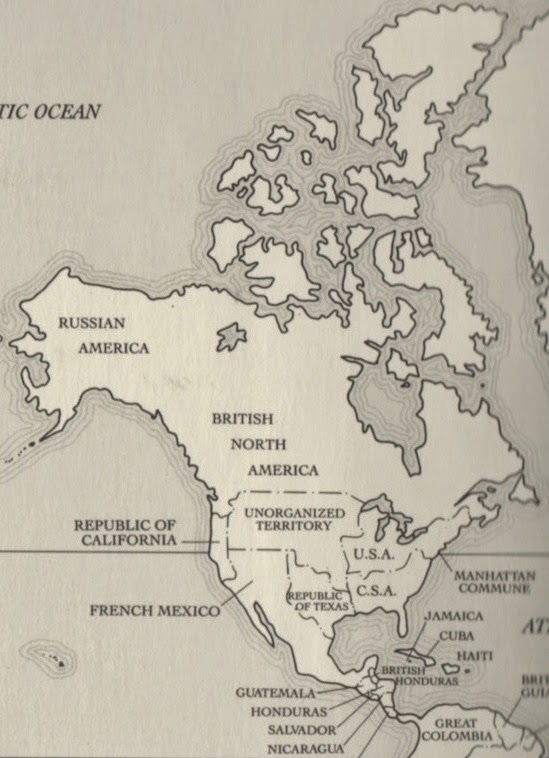
Now that we've all three finished John A.'s Crusade, I can finally mention my chief complaint: The sale of Alaska to the Americans.
Yes, we all knew it was going to happen. The anachronisms are accidents – Rohmer didn't mean to set the novel in an alternate universe.
My question is why. Why does Russia decide to sell the Alaska to the Americans?
As I remember it – please keep in mind that it's been more than six weeks since I finished this thing – all comes down to the Russians saying one thing and doing another. As Rohmer's novels teach, drunk or sober, Russians can't be trusted. Fair enough, but given that this is the decision around which the whole plot turns I expected more.
Or do I simply not remember?
In her Globe & Mail review (20 May 1995), Elizabeth Abbott writes: "Rohmer deals with this in a startling denouement in which we learn what Macdonald never did: precisely why the czar changed his mind."
Is Elizabeth Abbott right?
Am I wrong?
In the latter case, allow me to save face by correcting Professor Abbott: Our first prime minister didn't actually leave the London Conference for a top secret meeting with Alexander III.
A final complaint (because, really, after two months shouldn't we be done with it?): The half-hearted Fenian attempt on Macdonald's life. Coulda stabbed him as he slept. Coulda shot him through the heart. Instead, his room is set alight, the flames so weak that the rest of the hotel patrons sleep undisturbed.
The Fenians were never so subtle. For goodness sake, they shot D'Arcy McGee through the head a block from Parliament Hill! With Macdonald, some kid named Kelly – sorry, Chris – botches the job, after which they just give up. I was reminded of nothing so much as the Mafia's brutal attack on Paul James, Franz Huber and his ugly daughter in Retaliation. That was really something! But after it failed everyone went home, never to speak of it again.
Ah, well, at least they tried.
Friday, 24 October 2014
The way I sometimes write about Richard Rohmer you’d be forgiven for thinking that I can’t stand the man. In fact, the opposite is true. Sure, we often disagree, but I like the guy as much as you can like anyone you’ve never met. Generally Speaking makes me like him all the more. Rohmer's story is remarkable, even if the book isn’t. He’s accomplished so very much, is famous in his own right, and yet so often becomes star-struck in the presence of fame. There’s something endearing in that trait, and the effort expended in reproducing grainy video and coffee mug images.
Generally Speaking reads like a self-published memoir written by an amateur and published by a service like My Family Memoirs. Heavy on the positive, light on the negative, Jack Rhind’s autobiography is a good example. You’ll remember the former Confederation Life CEO as one of the men who provided a blurb for Retaliation. What makes this all really interesting is that Rohmer is an old pro, and Dundurn is no vanity press.
Though he doesn’t appear in Generally Speaking, I think Jack Rhind and Richard Rohmer were friends. I’m mentioning this only because it points to one of the more amusing quirks of the book. Friends and good friends populate its pages, they often appear out of nowhere and, once mentioned, usually disappear. This is exactly what happens with “friend King Michael of Rumania” – who comes and goes within a sentence. You want to put on the breaks, and ask Rohmer for more. An editor would do this, but I don’t see one in evidence. It's worth noting that Dundurn routinely credits editors on its copyright pages, but here lists only a copy-editor.
Is this part of a pattern he set with Ultimatum? The book doesn’t say. Having come to the man through his novels – as opposed to, say, his legal work for Bramalea – I found the most disappointing aspect of the biography to be how little attention is paid to his writing career. A few asides aside, it comes late – page 525 – and has to share a chapter – number 78 - with some unrelated stuff about George H.W. Bush and Brian Mulroney.
Generally Speaking numbers 590 pages, but I found myself wanting more. Too often things skim along the surface. You come away wondering why he quit the Progressive Conservatives or how, in late middle-age, he came to see E.P. Taylor as a “father figure”.
There’s a really good biography to be written about Richard Rohmer. He'd be the first to appreciate the amount of work involved.
Generally Speaking reads like a self-published memoir written by an amateur and published by a service like My Family Memoirs. Heavy on the positive, light on the negative, Jack Rhind’s autobiography is a good example. You’ll remember the former Confederation Life CEO as one of the men who provided a blurb for Retaliation. What makes this all really interesting is that Rohmer is an old pro, and Dundurn is no vanity press.
Though he doesn’t appear in Generally Speaking, I think Jack Rhind and Richard Rohmer were friends. I’m mentioning this only because it points to one of the more amusing quirks of the book. Friends and good friends populate its pages, they often appear out of nowhere and, once mentioned, usually disappear. This is exactly what happens with “friend King Michael of Rumania” – who comes and goes within a sentence. You want to put on the breaks, and ask Rohmer for more. An editor would do this, but I don’t see one in evidence. It's worth noting that Dundurn routinely credits editors on its copyright pages, but here lists only a copy-editor.
Is this part of a pattern he set with Ultimatum? The book doesn’t say. Having come to the man through his novels – as opposed to, say, his legal work for Bramalea – I found the most disappointing aspect of the biography to be how little attention is paid to his writing career. A few asides aside, it comes late – page 525 – and has to share a chapter – number 78 - with some unrelated stuff about George H.W. Bush and Brian Mulroney.
Generally Speaking numbers 590 pages, but I found myself wanting more. Too often things skim along the surface. You come away wondering why he quit the Progressive Conservatives or how, in late middle-age, he came to see E.P. Taylor as a “father figure”.
There’s a really good biography to be written about Richard Rohmer. He'd be the first to appreciate the amount of work involved.
Monday, 15 September 2014
Who likes Massacre 747? William Stephenson likes Massacre 747… or did. Me? I thought it was fine as far as instant books go. But then all Richard Rohmer books are instant books, right? Researchers are hired, blank cassettes are purchased and the dictator begins.
I admit I was impressed that Rohmer took the time to sit in a flight simulator – that is until I realized I was impressed that Rohmer took the time to sit in a flight simulator. What I was doing, of course, was giving credit for something that any writer might have done. Okay, maybe Sy Hersh didn’t – or did he? – but the Polk Award-winner interviewed all sorts of people, including aviation experts and members of the American military. What’s more, he travelled to the Soviet Union to meet Georgi M. Kornienko and Nikolai V. Ogarkov.
Rohmer, as Chris has pointed out, read some newspaper clippings.
Case in point: The description of Ogarkov’s news conference belongs to The New York Times. Rohmer tells us repeatedly that the reporter used the words “spellbinding performance”. What anyone else thought, never mind the author, is anyone's guess.
Ogarkov wields a pointer and wins “a classic rhetoric victory over the United States.”Writes Dictates the master of hyperbole: “It was the most successful disinformation and propaganda achievement in modern times.” Ronald Reagan's own disinformation campaign – all that stuff about the weather, visibility, navigational lights and radios – is ignored.
Rohmer's main argument is that the Soviets knew were shooting down a commercial airliner because they knew the Americans would never use a plane to spy on Soviet military installations. After all, they have the KH11 satellite, which can detect bolts lying on the deck of a ship (see Retaliation). And that is why the United States stopped using the U-2 in 1976.
Except that it still does.
Sy Hersh’s book took two-and-a-half years to write.
Has anyone else noticed that not one of the four non-fiction books we've read to date has featured citations, endnotes or a bibliography?
I admit I was impressed that Rohmer took the time to sit in a flight simulator – that is until I realized I was impressed that Rohmer took the time to sit in a flight simulator. What I was doing, of course, was giving credit for something that any writer might have done. Okay, maybe Sy Hersh didn’t – or did he? – but the Polk Award-winner interviewed all sorts of people, including aviation experts and members of the American military. What’s more, he travelled to the Soviet Union to meet Georgi M. Kornienko and Nikolai V. Ogarkov.
Rohmer, as Chris has pointed out, read some newspaper clippings.
Case in point: The description of Ogarkov’s news conference belongs to The New York Times. Rohmer tells us repeatedly that the reporter used the words “spellbinding performance”. What anyone else thought, never mind the author, is anyone's guess.
Ogarkov wields a pointer and wins “a classic rhetoric victory over the United States.”
Rohmer's main argument is that the Soviets knew were shooting down a commercial airliner because they knew the Americans would never use a plane to spy on Soviet military installations. After all, they have the KH11 satellite, which can detect bolts lying on the deck of a ship (see Retaliation). And that is why the United States stopped using the U-2 in 1976.
Except that it still does.
Sy Hersh’s book took two-and-a-half years to write.
Has anyone else noticed that not one of the four non-fiction books we've read to date has featured citations, endnotes or a bibliography?
Friday, 29 August 2014
I Have Seen the Future, and it Rohmers
I skipped ahead and read Massacre 747 last month. My copy arrived the same week Ukrainian separatists shot down a civilian airliner (with Russian weapons) and the coincidence was too eerie to ignore. Is life more like a Richard Rohmer novel -- repetitious and banal – than we care to admit?
Separation (1975) features a British prime minister named Margaret Thrasher four years before Margaret Thatcher takes office.
In 1980, Rohmer has PLO sappers in rubber rafts blowing holes in the sides of supertankers in Periscope Red. In 2000, Al-Qaeda uses a small boat to blast a hole in the USS Cole.
In Triad (1982) Iraq uses a nuclear weapon to stop Iran from taking Baghdad. In real life, Saddam starts using weapons of mass destruction against Iranian invaders in 1984.
In 1984’s Retaliation, Rohmer imagines Canadian banks buying American ones and making everyone crazy with awe. In 2004, Toronto-Dominion buys Banknorth, and then Commerce Bancorp in 2007. Although the Boston Bruins are compelled to play their home games in the TD Garden, war hasn’t broken out. Yet.
In Starmageddon (1986) Reagan builds Star Wars and it works. You can’t win them all.
In Red Arctic (1989) the Soviet Navy and the RCMP battle for control of Canada's far north. And that was before the ice started melting. Look, here’s the Economist, June 16, 2012:
“For half the 20th century the Arctic, as the shortest route between Russia and America, was the likeliest theatre for a nuclear war, and some see potential for fresh conflict in its opening. Russia and Canada, the two biggest Arctic countries by area, have encouraged this fear: the Arctic stirs fierce nationalist sentiment in both…
“Yet the melting Arctic will have geostrategic consequences beyond helping a bunch of resource-fattened countries to get fatter. An obvious one is the potentially disruptive effect of new trade routes. Sailing along the coast of Siberia by the north-east passage, or Northern Sea Route (NSR), as Russians and mariners call it, cuts the distance between western Europe and east Asia by roughly a third. The passage is now open for four or five months a year and is getting more traffic…
“For Russia, which has big plans to develop the sea lane with trans-shipment hubs and other infrastructure, this is a double boon.”
Spooky. He’s like that guy who could see the future. You know, Chris de Burgh. And here’s the kicker, from the Economist:
“There are risks in this, of dispute if not war, which will require management. What is good for Russia may be bad for Egypt, which last year earned over $5 billion in revenues from the Suez Canal, an alternative east-west shipping route.”
What’s good for Russia may be bad for Egypt? Not if snowshoe-wearing PLO assassins have anything to say about it.
Doe$ anyone el$e $mell a be$t seller?
If the major-general isn’t working on Red Arctic II, we may have to do it ourselves.
Labels:
Periscope Red,
Reagan,
Red Arctic,
Retaliation,
Separation,
Starmageddon,
Triad
Tuesday, 19 August 2014
Thing$ I Learned from How to Write a Be$t Seller
-- Rommel and Patton
(AKA Hour of the Fox) was originally
going to be called The Rommel Legacy,
and was going to be an alternative history of post-war Europe, if Rommel and
Patton had negotiated an armistice in 1944.
Rohmer writes:
“That kind of historical novel isn’t everybody’s cup of
tea…”
Or, apparently Rohmer’s.
The final book is 100,000 words about Rommel thinking about an armistice, but having a car accident
instead. The war follows its historical
course.
“Now all I have to do is write it…”
Or not.
-- Retaliation,
Rohmer’s business procedural about a Canadian bank taking over an American bank
wasn’t inspired by a internal memo from an unnamed Canadian bank called
“How to Take Over an American Bank.”
Rohmer was thinking about it before he came across the memo. So there.
-- Rohmer is aware that, in most literary works “conflict
grow(s) out of character.” This
well-worn path the master eschews.
“In my fiction the characters and actions are designed to
carry the message I want to get across… The characters personify institutions
or nations.”
What’s that Fitzgerald line about characters, and starting
out with a generalization and ending up with nothing? Well, not that. Rohmer starts out with President America and
ends up with a be$t $eller.
-- When Rohmer bases a character on a real person, he is
guided by a legal and artistic vision:
“I always have my thinly disguised character doing good
things.”
Too many writers of potboilers make up terrible things about
famous people and let the reader guess whom they might mean. (Result: Entertainment) Rohmer answers to a higher standard.
-- Rohmer freestyles his novels, and doesn’t like it when
people monkey with what comes out.
“You can dictate your thoughts into a machine or directly to
a stenographer… That’s the technique I use.” (p.62)
“When I got the manuscript back, the editor had altered
almost every sentence in the book. It
took me four days to erase 98 per cent of the changes.” (p.106)
Drop the mic.
Monday, 14 July 2014
Why a Castle? and other questions
Retaliation is a done dog. I know you both rate it highly – right up there with Exodus/UK and Separation – but I say only Separation Two is worse (and Separation Two should have been the subject of a Marketplace probe).
C'mon, you know I'm right – just look over your comments, consider your queries. I'll answer four:
1) Why are they in a castle?
During his meeting at Table 23, James tells Harris that BankAmerica has seventy thousand shareholders, adding “it’s a management-run castle we’ll be storming.” Harris replies, “Just like my own castle, the CIBC – or the TD or the Royal or Montreal…”
You see, it’s how you look at it. CIBC's offices aren't in a bland office building, but Commerce Tower. A tower, dammit! And TD Centre is a castle designed by Mies van der Rohe.
James rents Castle Berghof – not to be confused with Hitler’s Bavarian home – to make things more exciting. Sure, it’s too big and he's got to rewire half the Alps in order to communicate with other “computer machines”, but look at that drawbridge!
Man, two people trying to pull off a multi-billion dollar scheme, alone in a castle with no security, operating the most world's advanced computers without the aid of technical staff. Imagine the possibilities. What if the winch to that drawbridge jams?
Rohmer missed an opportunity there.
Just the same, it all comes down to derring-do, which is why Ross Harris fairly creams himself at Winston's when talking about hiring the Black Brigade.
Consider this exchange from page 26, in which our heroes imagine American reaction to their plan.
3 & 4) What happens when the dollar goes down to 60 cents? How do you explain that to the TD and CIBC shareholders?
Who cares. God, you should've seen the look on Philby X. Carter's face! It was priceless!
You have your questions, I have mine:
Why is FIRA invariably referred to as “Fira”?
How is it that at 8000 feet parachutists can see the Sterling's "lines of pipes, the catwalk and other equipment", but at 4000 feet "just barely make out the letter H" on the ship's landing pad?
Why does the vengeful Mafia give up on the Black Brigade?
Why doesn't the vengeful Mafia go after Paul James, Franz Huber and his ugly daughter?
If the Prime Minister recognizes that the Americans may consider the take-over of BankAmerica and Citicorp the final straw, why does he do nothing to stop it?
Why doesn't Harris regret bringing his bank to the brink of collapse?
Might selling interests in BankAmerica and Citicorp save Canadian banks from collapse?
Most of all, how are the Berghofs going to react when they see that the floor of their 12th-century castle has been tiled, its stone walls whitewashed, and its wooden ceiling painted?
C'mon, you know I'm right – just look over your comments, consider your queries. I'll answer four:
1) Why are they in a castle?
During his meeting at Table 23, James tells Harris that BankAmerica has seventy thousand shareholders, adding “it’s a management-run castle we’ll be storming.” Harris replies, “Just like my own castle, the CIBC – or the TD or the Royal or Montreal…”
You see, it’s how you look at it. CIBC's offices aren't in a bland office building, but Commerce Tower. A tower, dammit! And TD Centre is a castle designed by Mies van der Rohe.
James rents Castle Berghof – not to be confused with Hitler’s Bavarian home – to make things more exciting. Sure, it’s too big and he's got to rewire half the Alps in order to communicate with other “computer machines”, but look at that drawbridge!
Man, two people trying to pull off a multi-billion dollar scheme, alone in a castle with no security, operating the most world's advanced computers without the aid of technical staff. Imagine the possibilities. What if the winch to that drawbridge jams?
Rohmer missed an opportunity there.
Just the same, it all comes down to derring-do, which is why Ross Harris fairly creams himself at Winston's when talking about hiring the Black Brigade.
Consider this exchange from page 26, in which our heroes imagine American reaction to their plan.
Harris laughed. “In fact, they’d probably send in the troops.”
James chortled “I tell you, if we pull this off, what with all the other things […] the Americans will be mad as hell.”
2) Why do the Canadian banks want to buy the American banks?
Candidly, I think it’s a hell of an idea. It’s one of the most novel, challenging concepts I’ve run across in a long time. I think most of us in the banking industry need a good, stimulating kick in the butt like this once in a while.Marry that with the quotes of James and Harris. The answer is not "Because", but "Because you can." Imagine walking into Philby X. Carter's office and announcing that we're taking over Citicorp. Imagine!
– Don Franklin, Vice-Chairman and President, CIBC
3 & 4) What happens when the dollar goes down to 60 cents? How do you explain that to the TD and CIBC shareholders?
Who cares. God, you should've seen the look on Philby X. Carter's face! It was priceless!
You have your questions, I have mine:
Why is FIRA invariably referred to as “Fira”?
How is it that at 8000 feet parachutists can see the Sterling's "lines of pipes, the catwalk and other equipment", but at 4000 feet "just barely make out the letter H" on the ship's landing pad?
Why does the vengeful Mafia give up on the Black Brigade?
Why doesn't the vengeful Mafia go after Paul James, Franz Huber and his ugly daughter?
If the Prime Minister recognizes that the Americans may consider the take-over of BankAmerica and Citicorp the final straw, why does he do nothing to stop it?
Why doesn't Harris regret bringing his bank to the brink of collapse?
Might selling interests in BankAmerica and Citicorp save Canadian banks from collapse?
Most of all, how are the Berghofs going to react when they see that the floor of their 12th-century castle has been tiled, its stone walls whitewashed, and its wooden ceiling painted?
Saturday, 12 July 2014
Report from Table 23
![]() |
| Winston's Restaurant, as featured in Death Wish V: The Face of Death (1994) |
"Schmit says one of the principles that keeps the Mafia strong is revenge, an eye for an eye."
So, not let sleeping dogs lie. Good to know.
I sense a new element being added to the mix. Perhaps something to bring the level of violence to what Eaton's president and book critic Fred Eaton considers "appropriate".
Wednesday, 9 July 2014
Finished Retaliation.
The need for speed: why is there such an obsession with having things happen so fast in Rohmer world? Harris of the CIBC has a jet ready to go at a moment's notice if Paul James needs him for backup; the bankers fly off to see Citicorp and BankAmerica in LA and NYC as soon as the deal is done and essentially barge into the US offices to announce the takeover; The President and PM meet in Bermuda in a rendezvous arranged so quickly the Canadians don't even bring their team. People are always flying to make deadlines, rushing at breakneck speed across the globe to get things done. I know it must have seemed amazing to live in a world where air travel made this all possible, but there is a tinge of artifice to the urgency - all of it seems contrived to get pull quotes about how the story is so "fast-paced". Maybe after 9 novels I don't want to hear anymore about how tired people get from jetting about so.
And (Spoiler Alert) has there been a more downer ending to a Rohmer novel? Canada's economy is in shambles, hundreds of thousands are out of work, rioting is happening in the streets, Canada is out of NATO and NORAD had a 1300-mile gap in it. But at last Paul James and Sam get to frolic on a beach in the Barbados and forget about all that nastiness in the North and Potts has a great story to tell at the pub.
I want a whole book featuring Potts.
The need for speed: why is there such an obsession with having things happen so fast in Rohmer world? Harris of the CIBC has a jet ready to go at a moment's notice if Paul James needs him for backup; the bankers fly off to see Citicorp and BankAmerica in LA and NYC as soon as the deal is done and essentially barge into the US offices to announce the takeover; The President and PM meet in Bermuda in a rendezvous arranged so quickly the Canadians don't even bring their team. People are always flying to make deadlines, rushing at breakneck speed across the globe to get things done. I know it must have seemed amazing to live in a world where air travel made this all possible, but there is a tinge of artifice to the urgency - all of it seems contrived to get pull quotes about how the story is so "fast-paced". Maybe after 9 novels I don't want to hear anymore about how tired people get from jetting about so.
And (Spoiler Alert) has there been a more downer ending to a Rohmer novel? Canada's economy is in shambles, hundreds of thousands are out of work, rioting is happening in the streets, Canada is out of NATO and NORAD had a 1300-mile gap in it. But at last Paul James and Sam get to frolic on a beach in the Barbados and forget about all that nastiness in the North and Potts has a great story to tell at the pub.
I want a whole book featuring Potts.
Sunday, 6 July 2014
A QUIZ ON RETALIATION
PAGE 101 THROUGH PAGE 293
Q: I’m looking to hire some guys who know how to parachute
and fight terrorism. I was thinking of
the SAS, but are they highly trained?
“We’re also highly trained in rapeling and, of course,
parachuting day or night.” p. 186
“These are first-class, highly trained people.” p. 187
“We’re a highly proficient team of anticrime and
antiterrorist specialists.” p. 189
Q. What the hell?
“What I want to know,” the General opened, “is what the hell
you think you’re doing, making foreign-policy judgments and giving foreign-policy
opinions in front of the Foreign Relations Committee. Air defense. NORAD. The
Canadian Air Force’s capability. Who the hell do you think you are to make a
judgment about what they can or cannot do?” p. 179
Q. Tell me something I already know.
“… I am chairman and principal shareholder of SwissComp AG
which, as you know very well, fabricates some of the most advanced computers in
the world.” p. 112
“As you know it’s worked well for the American side, but the
Canadian bureaucrats are claiming they’re running a
three-and-a-half-billion-dollar deficit this year.” p. 122
“It’s been getting worse every year since… You know what the
numbers are.” p. 124
“I’m sure you realize, Mr. Harris,” the PM said sternly,
“that what you people are doing is going to cause a tremendous strain between
the United States and Canada, whether you pull it off or not.”
p. 199
“As I told you, Tom and Mike are going to go back on Monday
after they get some cash out of the bank. p. 251
Q: What is “rapeling”?
Saturday, 5 July 2014
I spent my Fourth of July reading Retaliation. You?
The first chapter makes the heart sink, doesn’t it? Not 500 words in and we’re already dealing with nine characters (and I’m not even counting the Black Brigade or the five guys sitting around Enzio Palangio’s kitchen table). Which to follow? You just know that, like Ama in Triad, some will prove to be nothing more than distractions. Sure, “plans were being laid and plots prepared”, but half will be entirely inconsequential.
You’re right, Chris, THIS is Rohmer. It’s all here. We’re barely into chapter two before the major-general feels the need to tell us that GATT stands for General Agreement on Tariffs and Trade. It’s perhaps because he’s a military man that he thinks you haven’t heard of the SAS… and weren’t paying attention the first, second and third times he told you about them.
Really, what reader of political thrillers hasn’t heard of the SAS? Maybe I’m mistaken for thinking of this as a political thriller. Maybe this is a business thriller, with excited talk of exchanging photocopies over “executive salads – shrimp, roast beef and onion chips served on a bed of lettuce with John Arena’s special dressing.”
The Black Brigade parachute jump and promise of something bad involving Palangio (a character mentioned on page 7, then not for 110 pages and counting) are there to provide some sort of action. Without them, it's just Gino being picked up at the airport.
Yep, this is a business thriller. How else to explain the inclusion of Winston’s Restaurant (“the best in Toronto… top watering hole in all Canada"). It was run by real life “affable owner and manager, John Arena”, whose “remarkable entrepreneurial energy and drive” is credited with maintaining Winston’s reputation.
You know there’s nothing that interests Rohmer more than entrepreneurs and energy.
And how 'bout that plug for the King Edward Hotel? “They’ve done a great job in remodelling the place… Beautifully done.”
Not to suggest that Rohmer has no imagination. I think he could picture lawsuits had he not used Canadian International Bank of Commerce in place of Canadian Imperial Bank of Commerce, Toronto Depository Bank in place of Toronto-Dominion Bank, etc. etc.
I’m hoping that Margaret Thrasher appears at some point. Secretary of State for External AffairsMark MacGuigan Mark MacGregor isn't shaping up to be as much of a treat.
Does Rohmer’s fun with names explains why the Centre Block is referred to as the “Center Block”. Doubt it. He should know that the Peace Tower’s clock is not a copy of Big Ben, Its hands, the largest of which is about two metres in length, cannot “be seen for miles”.
Am I being a bastard again? I spent the First of July rereading Brian Moore’s Lies of Silence. That's my excuse. Everything else seems so small.
Two questions:
The first chapter makes the heart sink, doesn’t it? Not 500 words in and we’re already dealing with nine characters (and I’m not even counting the Black Brigade or the five guys sitting around Enzio Palangio’s kitchen table). Which to follow? You just know that, like Ama in Triad, some will prove to be nothing more than distractions. Sure, “plans were being laid and plots prepared”, but half will be entirely inconsequential.
You’re right, Chris, THIS is Rohmer. It’s all here. We’re barely into chapter two before the major-general feels the need to tell us that GATT stands for General Agreement on Tariffs and Trade. It’s perhaps because he’s a military man that he thinks you haven’t heard of the SAS… and weren’t paying attention the first, second and third times he told you about them.
Really, what reader of political thrillers hasn’t heard of the SAS? Maybe I’m mistaken for thinking of this as a political thriller. Maybe this is a business thriller, with excited talk of exchanging photocopies over “executive salads – shrimp, roast beef and onion chips served on a bed of lettuce with John Arena’s special dressing.”
The Black Brigade parachute jump and promise of something bad involving Palangio (a character mentioned on page 7, then not for 110 pages and counting) are there to provide some sort of action. Without them, it's just Gino being picked up at the airport.
Yep, this is a business thriller. How else to explain the inclusion of Winston’s Restaurant (“the best in Toronto… top watering hole in all Canada"). It was run by real life “affable owner and manager, John Arena”, whose “remarkable entrepreneurial energy and drive” is credited with maintaining Winston’s reputation.
You know there’s nothing that interests Rohmer more than entrepreneurs and energy.
And how 'bout that plug for the King Edward Hotel? “They’ve done a great job in remodelling the place… Beautifully done.”
Not to suggest that Rohmer has no imagination. I think he could picture lawsuits had he not used Canadian International Bank of Commerce in place of Canadian Imperial Bank of Commerce, Toronto Depository Bank in place of Toronto-Dominion Bank, etc. etc.
I’m hoping that Margaret Thrasher appears at some point. Secretary of State for External Affairs
Does Rohmer’s fun with names explains why the Centre Block is referred to as the “Center Block”. Doubt it. He should know that the Peace Tower’s clock is not a copy of Big Ben, Its hands, the largest of which is about two metres in length, cannot “be seen for miles”.
Am I being a bastard again? I spent the First of July rereading Brian Moore’s Lies of Silence. That's my excuse. Everything else seems so small.
Two questions:
Is Gino Ianni the only person born and raised in Detriot to have never crossed the Detroit River?
How is it that a man who was once “Vice-President of Corporate Affairs at General Motors with special responsibility for the ‘free trade’ auto-pact between the United States and Canada” has never once visited Canada?
Thursday, 3 July 2014
A QUIZ ON RETALIATION PAGE
51 THROUGH PAGE 100
Q: What nation did Canadians blame for high interest rates, unemployment and bankruptcies?
They were mad at the
Americans and their high interest-rate policies that were bankrupting Canadian
companies and extinguishing jobs from coast to coast. p. 67
“The editorial writers
here are saying that the U.S. policies are responsible for two million people
being out of work in Canada… They blame us for the high interest rates and the
record number of bankruptcies.” p. 67
Q: A highly
trained retired SAS officer jumps out of a plane. What is his terminal velocity? Bonus: How many seconds would it take to
reach this velocity?
The mask would have to
withstand an air force of one hundred and twenty miles per hour, the terminal
velocity each man would reach during the free-fall drop. p. 77
After leaving the
aircraft, the jumper would accelerate for the first twelve seconds of the fall
– about 1,480 feet – to the terminal velocity speed of one hundred and twenty
miles per hour. p. 79
Their acceleration was
rapid: after twelve seconds of fall – about 1,480 feet – they were at their
terminal velocity speed of one hundred and twenty miles per hour. p. 85
Q: Tell me something I already know.
“As you know, Paul, we
have a fairly substantial operation right now in the States, with about
thirteen banking offices in New York, California, Georgia, Illinois,
Pennsylvania, Oregon and Washington.” p. 55
“As you know, I have a
letter from the President, which I’ll give to the Prime Minister tomorrow.” p. 64
“I’m sure you’re aware
that Kuwait has been moving out of U.S. treasury bills and short-term paper,
and getting in to equity-control positions.” p. 94
Wednesday, 2 July 2014
Now THIS is Rohmer.
Only fifty pages in and already I have two nominees for the
Single Greatest Rohmer Line of All Time:
The Rohmer Military
Man, Very Excited About the Meeting He’s Prepared
His telescopic pointer
was extended, at the ready.
The Rohmer President,
Tough as Balls
“Okay, Gino, it’s
sanction time.”
And beaver bashing. And tankers. And a fantastic international plan to buy something, but Rohmer’s not
telling you what. (But come on, it’s an
oil company.) And the purpose of buying
this company? To then own it. It’s so
devilishly simple!
And sexy action power salads in the restaurant at the hotel.
This is The
Expendables of Rohmer paperbacks. It
has everything.
And best of all, the glorious Rohmer Repeats.
A QUIZ ON RETALIATION PAGE 1 THROUGH PAGE 50
Q: Where did Paul James go when he left the bank? And where
is the center of Canada’s oil patch?
Paul James had gone
out to the oil patch in Calgary where he had made a fortune. p. 1
James had left the
bank and gone to Calgary, the center of Canada’s oil patch. p. 20
Q: What did Ross Harris do in the war? And when was D-Day?
Captain Harris of the
First Canadian Parachute Battalion had parachuted into the beachhead area in
France in the early-morning darkness on D-Day, the sixth of June, 1944. p. 20
“I’m an old army
parachute battalion man myself—1st Canadian Parachute
Battalion. We jumped in at the beachhead
on D-Day morning.” -- Ross Harris P. 31
Q: What is the SAS? Are its members highly trained?
… the fabled British
SAS, the Special Air Service, probably the most highly trained, efficient,
antiterrorist military unit in the world. p. 1
“They’re retired
members of a crack antiterrorist British Army organization called the Special
Air Service.” p. 31
“Quite, the Special
Air Service, Her Majesty’s absolutely top antiterrorist, anti-everything
force. My dear chap, there’s no more
highly trained, highly skilled unit in the world.” p. 43
His people were all
former SAS colleagues, highly trained… p. 43
Q: What the hell?
“What the hell do you
want Arab money for?” p. 22
“But how the hell are
you going to bring off this covert business?” p. 23
But how the hell
would the senior senator from Florida come up in short order with a researched,
intelligent answer to that question? p. 35
“For chrissake, Gino,
what the hell do I care what you’re going to do to those dumb Canadians about
their goddamn confiscatory National Energy Program…?” p. 37
"What the hell do you
mean my that?” p. 41
Q: Tell me something I already know.
And you know, Jim, all
of these big takeovers happened because that goddamn government up there has
set up a fortress. p. 10
“But, as you know, my
people in State and I are sensitive.” p. 33
I've started Retaliation and am pleased to find many old favourites are back:
1. Chapter two begins with the US President (another President as main character!) and Jim Crane telling each other things they already know.
2. An ultimatum delivered to the Japanese Ambassador.
3. A main character who made his fortune in the oil business.
4. Thinly-veiled Trudeau bashing ("That socialist bastard up there in Ottawa")
5. A deal brewing to take over a major US company (wait a minute - didn't Pierre de Gaspe already do this? Maybe not - by page 40 I still don't know the target of the takeover bid - maybe it's NOT an energy/oil related takeover this time).
Why does Chapter 1 read like a pitch?
My new favourite Rohmer line, deliberately quoted here out of context for effect: "It'll be a cosmetic carrot for the beaver before I hit it between the eyes with my sanctions!".
1. Chapter two begins with the US President (another President as main character!) and Jim Crane telling each other things they already know.
2. An ultimatum delivered to the Japanese Ambassador.
3. A main character who made his fortune in the oil business.
4. Thinly-veiled Trudeau bashing ("That socialist bastard up there in Ottawa")
5. A deal brewing to take over a major US company (wait a minute - didn't Pierre de Gaspe already do this? Maybe not - by page 40 I still don't know the target of the takeover bid - maybe it's NOT an energy/oil related takeover this time).
Why does Chapter 1 read like a pitch?
My new favourite Rohmer line, deliberately quoted here out of context for effect: "It'll be a cosmetic carrot for the beaver before I hit it between the eyes with my sanctions!".
Subscribe to:
Posts (Atom)


