Showing posts with label Exxoneration. Show all posts

Wednesday, 13 July 2016

Reading Richard Rohmer in The Walrus!


I'd like to think that we've reached new heights, but as my agent will attest, I'm not one for promotion.

Is evidence required?

Consider the simple fact that I'm only now mentioning my 29 June article for The Walrus.

Remember when Michael Cimino was still alive?

Yeah, it's been that long.

You'll find the piece here:


Friday, 24 July 2015

Rescuing Richard Rohmer


In the beginning…

In the beginning I thought this would be an inexpensive exercise. Rohmer sold a lot of books, right? I expected them to turn up at thrift shops, garage sales, church rummage sales and library book sales.

They didn't.

I failed to factor in the law of diminishing and greater returns. Folks in publishing will know what I mean.

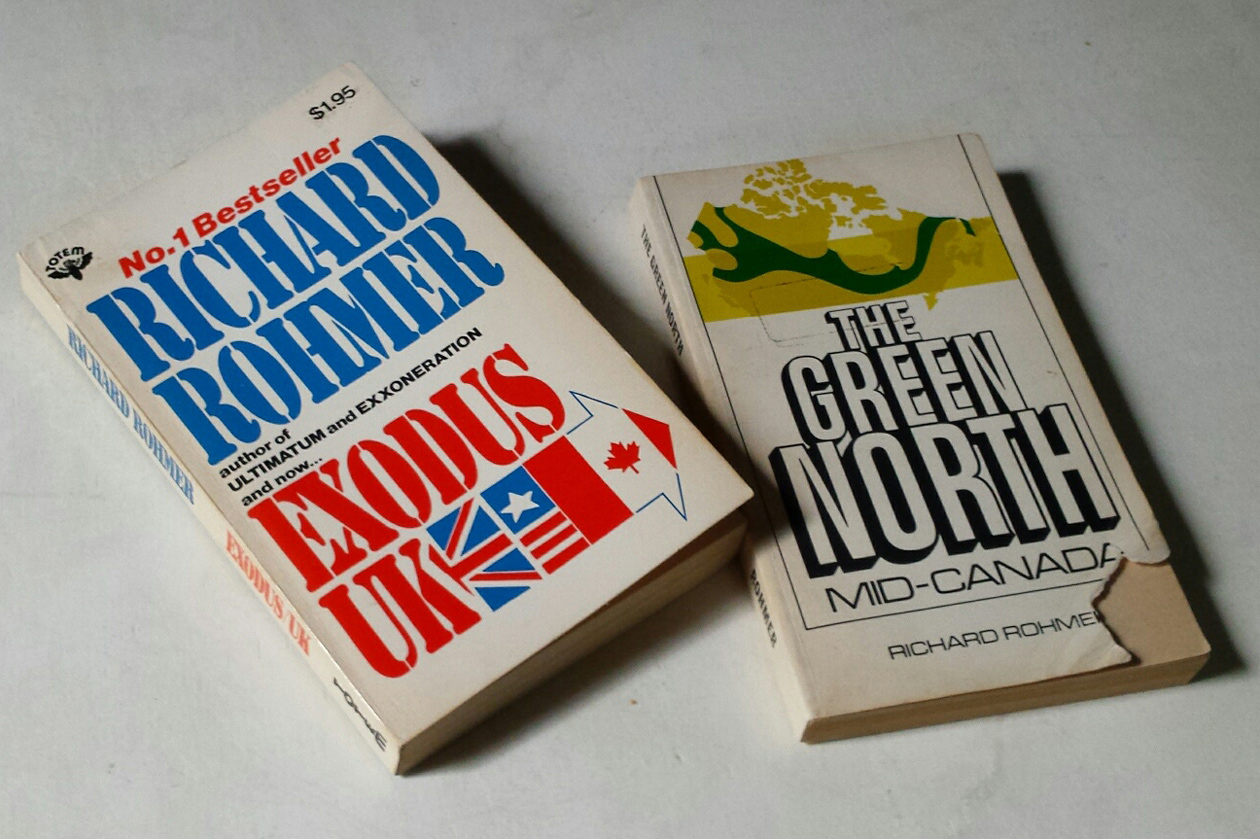
Anyway, today's visit to the Stratford Salvation Army Thrift Store brought the above.

The signed first edition of Exxoneration is free to whoever wants it… 'cause, you know, I already have one.

Stan, the Perelman is yours.

Thursday, 13 February 2014

I think you're on to something, Stan. The characters represent large groups of people, which is why we never saw the public at all in Ultimatum and Exxoneration. In this way, Exodus/UK is something of a breakthrough… something, because Jenny and the tens of thousand of rioting Britons are really just the Communist Party. The Parliament Hill protesters are equally uniform:
Apparently they were all French-Canadians. Shouting in French, they held signs such as, "anglais, stay home," and "Vive le Québec libre," and "Quebec out if anglais in." Nowhere was there a banner to be seen in support of letting the British in. Not one.
Yes, they're all French-Canadian, because no one else would object to the sudden influx of two million refugees. Where's our Communist Party?

Q: What are we to make of those odd bilingual signs and the fact that "Anglais" should be spelt with a capital?

And another: Where were the Israelis in all this? After all, it was their purchase of Rapiers that brought about this crisis, yet there's not a word from Israel in the entire novel.

Thursday, 6 February 2014

Another thought:  We should be giving these letter grades.  (After we've read a few more.)  Exodus UK is a lot better than than the first two.  There's a reasonable battle scene -- with foreshadowing, a Rohmer first! -- and at least two characters with personalities.  Or at least the personalities of reasonably well-thought-out characters on The Bold & Beautiful.

And you get nearly to the 100-page mark in EUK before a world leader -- for NO REASON AT ALL -- announces that he has made his mind up about the book's key issue, but won't say what he's decided.  Rohmer's three-for-three on that one.

Not really related, but did you ever notice, on Star Trek -- any of the Star Treks -- whenever the captain is away from the bridge, and something happens on the bridge, they call him and say:

CREWPERSON (V.O.)
Captain?

CAPTAIN
Captain here.

CREWPERSON (V.O.)
Captain, you'd better come see this.

CAPTAIN
I'll be right there.

(Pulls boots on over velour clamdiggers. Exits.)

Often klaxons are going off.

But why don't they tell him what it is he has to see?  Wouldn't that be better?  He could think about it in the turbo lift.  Get a start on a plan.

Now that I think of it, it also happens whenever the captain is on the bridge and gets a call from the doctor.

DOCTOR (V.O.)
Captain?

CAPTAIN
Y'ello.

DOCTOR (V.O.)
You'd better come down to sickbay and see this.

And off he goes.

Speaking of science fiction -- and grading Rohmer -- have you guys ever read The Space Traders by Derrick Bell?  Some politicians deal with a crisis, and what follows makes horrible sense.  And you read it and think: Yeah, that sounds about right.  Those guys would phone those guys.  That's what they'd suggest, and that would be what they'd do, and that's what would happen after that. And it's about something important -- the author has a political point to make -- and it goes somewhere really dark.  It's -- what's the nice way to say this? -- better than Richard Rohmer.

Hey, here's a link:

http://www4.ncsu.edu/~mseth2/com417s12/readings/BellSpaceTraders.pdf

So let's call it an A+.  As an example of the kind of story where the atmosphere in the Oval Office of the White House is tense.  Let's call Transformers: Dark of the Moon an F.

What do you give ULTIMATUM? What do you give EXXONERATION?

Sunday, 2 February 2014

I had a thought:  We should keep a running tally of Rohmerisms.  (I know, this means going back.  But maybe not.)  Number and type of useless illustrations and maps.  (Why, there's London! Right there in England!)  Uses of the phrase "as you know."  Number of meetings, times number of participants; estimated amount of danish consumed based on .8 danishes per person.  Typos.  Pages before first mention of natural gas, islands in arctic Canada that might contain same.  Speaking parts for women, total number of words spoken by women, descriptions of woman as either "pretty" or "little."

I don't want to panic anyone, but as you know, two books a month, we're never going to reach our goal.  He said.  The atmosphere was tense.

Friday, 31 January 2014

Why I Love Rohmer

I want to come back to my theory that Richard Rohmer only started reading novels after writing ULTIMATUM.  (Okay, maybe someone left a copy of The Moneychangers in the seatback of a CP Air flight from Toronto to Winnipeg, and he flipped through that, because he'd met Arthur Hailey at a party.  Or maybe he remembered Treasure Island from school.)  What we're seeing is a pretty sharp guy getting interested in a hobby.

He's picking things up on the fly.

That's why ULTIMATUM and EXXONERATION have completely pointless maps and drawings of planes.  (I think he thinks it feels like something you put in a book.) And why he tries little thriller tropes and then abandons them.  Sometimes entire plots are begun and abandoned.  And why we're always getting news dumps of information that never turn out to matter to the plot.  (The giant tanker airplanes?  Gaspe's ex-wife and the handsome doctor? The two-million-dollar bribe? The inflatable undersea pipeline that either works or doesn't, I forget?)

He's goofing around.

Exodus UK, his third thriller, is the first one that begins with a list of characters.  I truly believe this is because someone told Rohmer that's how thrillers begin...

Prime Minister of Great Britain        Jeremy Sands
Chancellor of the Exchequer            Michael Hobson

... and 25 more, like...

VC-10 Engineer                               F/O Jason Rupert

But here's the thing.  When you do this in a mystery novel, presumably you're doing it so the reader can encounter a name and quickly refresh his memory without a lot of flipping around. "Weidlinger? Who the hell is Weidlinger?"  You look at the front piece or the back page and it says, "Weidlinger: Col. Forbisher's ex-partner in the jade importing business."

Rohmer has the list backwards.  It should be the character's name, and then who they are in the story.  What he's written is movie credits.  Like the Prime Minister is being played by someone named Jeremy Sands.

Because he doesn't know why other authors put character lists in their books.  He's just doing it because he's trying things out.

In the immortal words of Van Morrison: "Checking it out, taking it further. Taking it further, checking it out."

My copy of Exodus UK – a first edition in not so great shape – arrived today through inter-library loans, so I say yea to the novel.

It would be great if Rohmer gets better and better. Does he? All I can say at this point is that Exxoneration was every bit as good as Ultimatum. Greene knew his first books weren't very good. Closer to home, I think of Mordecai Richler, who for many decades prevented his first novel, The Acrobats, from being reprinted.

(Still don't know what to think about it being reissued just months after the man's death.)

And let's not forget that The Apprenticeship of Duddy Kravitz, the first truly worth reading, was his fourth novel. Pal Brian Moore hit it out of the park on his first swing… and Greene though Moore was the greatest living English language writer.

Chrystia Freeland is very, very smart. Expect to see her in cabinet following the next election.

You can tell her I said that.

Wednesday, 29 January 2014

If we all own copies of Exodus UK I think that's the one we should do next.  Having it in paperback instead of on the iPod will shame me into reading it faster.  Because it's about 99 pages long.

When I used to take the subway to work from Brooklyn I wondered if I was seeing the same people every day, and if they wondered why it was taking me a month to read the same book.  Now I drive, and I don't think at all.

Wouldn't it be great if Rohmer kept getting better and better?  Graham Greene knew his first couple of books weren't very good -- The Man Within and two he wouldn't let anyone reprint in his lifetime. (I've never read them.  But if they're worse than The Man Within, they're pretty bad.)  Rohmer's smart...  what if the next five books are nail-biting edge-of-your-seat page-turning super-thrillers?

And if he ever had a George Lucas twinge to go back and translate Ultimatum into English.

Speaking of Parliament and high-stakes suspense, Chrystia Freeland is on the show this Friday.  Will someone bother her afterwards and pepper her with questions about Richard Rohmer?

"The atmosphere in the green room was tense..."

Tuesday, 28 January 2014

Brian - turn that counter over to # 2.

"events unfold at such speed, yet both plod".   Brian - you've just summarized everything perfectly.  Exxoneration really does move at breakneck speed, yet every time we build to a scene of potentially high drama, someone has to take the time to explain things at length.  The judge's summary, the Saudi Arabian minister's lesson in OPEC geopolitics - it's always a good time to stop and go over things.

You've both already talked about the extremely discomforting way the President being Jewish is handled.  The big reveal is rather unnerving; even for its time it's a little ......... indelicate.

I know I made a comment about their being no love story in Ultimatum and after the liaison between Cameron and de Gaspe, I'm sorry I asked.  That flirtation scene was particularly painful - Maggie got to tell de Gaspe all about himself ("Here you are, thirty-nine years old, tall, dark and handsome, and enormously intelligent and well educated"), he gets to soak it in and compliment her on being appointed by the PM to both the Senate and Board of PetroCan ("I might say that that was one of his better movements on the day he did it, or should I say actions").

Wait a minute - what?

And can I get picky here, but who copy-edited it?  My quote above reproduces "well educated" as it appears - without the hyphen; in one scene de Gaspe "lay (on his bed) starting (sic) at the ceiling"; in another Judge Avory  praises the Exxon witnesses "expecially (sic) Mr. McGarvey".  I came across 7 or 8 of these; the last two are the only ones I wrote down.

But I must say - in the end it was more fun than Ultimatum - aside from the looney military interlude that I expected would go on throughout most of the book - I find Rohmer has a much better grasp of creating a story that takes place in the financial world.   And in Senator Weinstein, we have a sort-of- kinda villain who doesn't speak in explication.  Admittedly his purposely grating "Pierre Baby"  makes him sound more like what 70s sitcoms told us slick Hollywood agents sounded like rather than a devious politician, at least he didn't sound like every other character in the book.

So do we go on to Periscope Red?
For the record, I didn’t really think that President Dennis’s religion would play a role. It’s really there to remind us all that the novel is set in the far-off 1980s. Black presidents were once used the same way. I’d have used a second Catholic president myself.

Anyway, good that level-headed, likeable Dennis is there, because he does provide balance for Weinstein. I was much more interested in Margaret Cameron and her remarkable dancing eyes. A cha-cha as de Gaspé, the Least Interesting Man in the World™, works to woo her with talk about his nature, his genes, his ideas, his building blocks, and his general superiority.
“Keep going,” she said, “I’m interested. There are certain personal questions I won’t ask you. But I’m interested in what makes you tick.”
And so he does. And his wooing works: Toronto, Thursday, March 26, 1981, 11:00 P.M.

What I find most remarkable about Ultimatum and Exxoneration is that events unfold at such speed, yet both plod. In October, Margaret is the deputy premier of Nova Scotia. Twelve weeks later, she’s sitting in the Senate and on the board of Petro-Canada after having lost a month-long campaign for re-election.

(I blame her defeat on the missing premier.)

We have de Gaspé ordering two hundred or so American soldiers incinerated in October, then making a bid for Exxon in January. No one mentions that "skit" (his word) at the airport, not even straight-talking Senator Weinstein. And no one suggests that the hostile take-over of Exxon just might go over better with the grieving American public if someone other than de Gaspé is seen to be at the helm.

October is so last year.

One last observation: All things considered, two million dollars – $5.6 million today – doesn’t seem like much of a bribe.

Ultimatum begat Exxoneration, but I’m not certain Exxoneration begat Exodus UK. From the little I’ve been able to gather, Periscope Red comes from an entirely different series. But why not? Surely there’s a reason why it’s in the Omnibus.

Monday, 27 January 2014

Okay.  Done.

A couple of things in no particular order.

Rohmer and Jewish people.  If you're a Jewish character in a Richard Rohmer novel, it's going to come up a lot.  Like every time you're mentioned.  Like some kind of Homeric device.  There's a great Jimmy Breslin character in The Gang That Couldn't Shoot Straight, whose introduction is something like:

Beppo the Dwarf, so called because he was a dwarf.

But Breslin is kidding.  Rohmer's Jewish President is so Jewish he's Jewish.  ("As you know, I'm not Orthodox...") But at least he's a half-decent guy.  Unlike Weinstein, the Senator from New York, who blows cigar smoke in people's faces and bribes and blackmails them whilst calling them "baby."

It might not be so bad, if other characters had more character, but as it is, it's sort of... what's the word I'm looking for ... uncomfortable?

The scenes in the Oval Office continue to be the most howlingly awful and wooden.  Other sections are dull, but only when Presidents are involved does Rohmerworld sound completely like it's being imagined by a visitor to the planet who speaks no known Earth language.

Canadian-U.S. relations.  There doesn't seem to be any left-over animosity from Canada killing all those troops at the airport.  200?  Or maybe that's why Congress votes the way it does.

The President's announcement that he won't tell anyone how he's going to vote. Because why?  Just because.  Not unlike the Prime Minister in Ultimatum.  This is inexcusably lame.

Stan's point, that it would be awfully difficult for the President of France to sneak up on a summit meeting, goes double for the ambassador from Saudi Arabia bursting into the Oval Office.

I still like Rohmer though.  And there are a couple of paragraphs in Exxoneration that sort of resemble an actual thriller, or at least a melodrama, or, okay, just a story.  As opposed to an idea, "what if GM tried to corner the banana market," stretched out over a number of meetings where people explain the idea to each other, with the only suspense provided by one character -- for no reason at all -- announcing that he won't tell you what he thinks of the idea until later.

On to Periscope Red?  That's the next book in the Omnibus.  Or is Exodus UK the next in series?

Sunday, 26 January 2014

As I head toward the end (it's in sight!) I have to ask you both - what did you think of his choice of having Valery Giscard D'estaing, at the time the real President of France, appear as a character?  It kind of caught me off guard - and why does he speak in fluent oil industry expertise?  (answer:  because everyone else does!).

Saturday, 25 January 2014

Truth is, I finished Exxoneration last weekend. Didn't want to put pressure on you guys.

Still don't.

Anyway, you're sure to catch up and then pass me by because I can't find a copy of Exodus UK, next in the series. What happened to the paperback I bought at Kane's Super Drug Mart in grade eight? I should keep better track of my things.

While I wait, can I ask you both about The Richard Rohmer Omnibus? I'm curious to know just how Exxoneration looks because my McClelland & Stewart first edition ranks amongst the ugliest and sloppiest productions I've seen. Nothing wrong with the cover; a nice, clean commercial design, you might even say it's inspirational.


But the rest is a dog's breakfast filled with poorly laid out maps, diagrams, illustrations. and technical drawings, none of which are particularly helpful. Here's a map of Toronto International Airport, printed without its key:


Chris, you've already mentioned the drawing of the rocket. Don't know what it looks like on an ereader, but I'm betting it's better than this two-page spread:


Poorly laid out? I stand by my words:


And what are we to make of this? A deleted paragraph or just more sloppiness?


When combined with appendices, all help give a 48,000-word novella the appearance of a 213-page novel.

That's right, novella.

What's taking you guys so long?

Fun fact: McClelland & Stewart turned down Ultimatum.

More fun: My copy, purchased in 1998 at a Toronto Goodwill, is signed.


Cost me $1.50.

Are we going to set a date for finishing this book?  I've been thinking that may be the best way to move forward.  Especially since I just got a lovely package of Rohmer paperbacks -- thanks Brian, and your "supplier" -- and it's kind of daunting, and it occurs to me that these are the easy ones.

I also never appreciated that so many of them fit together, like Foundation crossed with "A Visit to Ottawa, Our Capitol."

One of the paperbacks has a blurb on the back from an executive at Eatons.  So you know it's good.

I need to talk about the plot changing direction in Exxoneration, but I don't know where you guys are in the book.  If you're still in the first part, where it's moving along so nicely, with the war and everything, before he just sort of loses interest in that, and decides it's really about PetroCanada buying Exxon.  I'm not getting any sleep tonight!

Thursday, 23 January 2014

The issue with inconsistencies is that we always want to believe sequels or series are thought out in advance rather than after-the-fact ideas spurred by a book being a bestseller and there being pressure for a sequel.  (The big exception being George Lucas and Star Wars, as we all know he had fully plotted out all 9 movies before shooting the first one, so there were no inconsistencies along the way.  Hence everything in every movie makes perfect sense.  If you don't think so it's likely you're wrong, not George Lucas).

But as I get further into Exxoneration I do share both Brian and Chris's exasperation at this revisionist tendency.  Maybe it seemed like a cool Rashomon/Pulp Fiction trick to start the book by revamping the end of Ultimatum, but it just feels like second thoughts that "corrected"  the way the first book played out so he can take things in another direction.  

On the plus side, as the story progresses the planning and discussions of planning seem to be less prevalent.  But I am curious about getting to How to Write a Bestseller to see if he uses his own work as examples.  I look forward to discussions of filling your book with discussions of discussions that need to be planned.  Now that's how you move a story forward.

Monday, 20 January 2014

I see now it's this obsession with inconsistencies that's making Exxoneration such a chore. There can be no other reason.

Two more and that's it. Promise.

In Ultimatum, we're told that Porter became prime minister in August 1980 as the result of a leadership convention (defeating poor, bumbling Otto Gunther from Newfoundland). In Exxoneration, we're told that he became prime minister in August 1980 after his party won a federal election.

In Ultimatum, we're told - but only once - that President Blank is a Democrat. In Exxoneration, he's defeated in the 1980 presidential election by a Democrat. Not the Democratic National Convention, the election.

Look for the new president's religion to play a significant role - it's mentioned a lot.

Chris: The working title of Harriet Marwood, Governess was The Whipping Boy.

Sunday, 19 January 2014

The new Tom Clancy / Jack Ryan movie came out Friday and died like a dog.  It looked pretty familiar.  I have to admit the only Tom Clancy book I've ever read was one of the non-fiction ones, about submarines, and I'm pretty sure there were actual submarines that had fewer people working on them than worked to produce a book "by" Tom Clancy from that period.

So I wonder if the dialogue in his fiction is as... what's the opposite of lifelike? Expressionistic? ... as Rohmer's.

I know what you mean about feeling like the first couple of chapters of EXXONORATION undid the last couple of chapters of ULTIMATUM.  There's a funny moment in one of the Scream movies where someone lays out the laws of sequels, and one involves creating a new back story -- that happens before the first movie -- and ruins it.  This is kind of that, right? Or maybe it's closer to a type of classic cliffhanger escape, where the next episode reveals that although the car DID go over the cliff, what you didn't see was that the hero got out just in time.

I was working at a studio that used to be Republic, and had all the titles of their old serials on tiles in the cement.  I was curious, so I bought one on VHS -- Zorro's Black Whip -- and watched about 20 chapters in a row.  (Hey binge watching!) They got out of every cliffhanger by reshooting the ending and making it slightly different.  Of course, if you were seeing it in a theatre the next week, you'd have to trust them, that you had just remembered it wrong.

I wonder if people thought they were losing their minds?

Anyway, yes, Rohmer forgot to mention that the Canadian Armed Forces had been mobilised to repel history's greatest superpower by getting to the Toronto airport first and hiding at the arrival gate.

(I'm perfectly willing to go along for the ride, by the way -- okay, sure, America is going to invade Canada to get our natural gas -- but I feel like it would be more realistic if America just announced there was a crisis in Canada, and took over the government to restore stability.  Temporarily, you know?  At the invitation of a coalition of concerned nations, and/or the Frums.  Then you wouldn't need to take the whole country.  Just Parliament.)

And now we get to meet Pierre Thomas de Gaspe, the Least Interesting Man in the World.  And we get to hear about the President's adviser "Irving Wolf" and his nose, again, not once but twice.

My favourite Rohmer line so far:

"Even though I've known you for years, Pierre, I had no idea you were involved in the military..."

My second favourite:

"The atmosphere in the Oval Office of the White House was tense."

Brian: Why didn't John Glassco ever write a book called Zorro's Black Whip?

Saturday, 18 January 2014

Yes, Exxoneration, if only because it's inextricably linked with Ultimatum. Funny, I remembered it as being a sequel, but now see that it's more a reworking - at least for the first forty-four pages. After all that time and attention invested in Ultimatum I'm feeling cheated. All those meetings, briefings, phone calls, and behind the scenes consultations, and nothing on an operation that would've surely been the prime minister's chief concern.

In a way, it's like having a series reboot after just one episode. Remember in Ultimatum when President Blank placed an embargo on the transfer of American funds into Canada? Remember how Porter got really upset? Remember how he managed to get the president to back down? In Exxoneration we learn that not 24 hours later Porter closed the border, then closed the airports, then rounded up all the CIA operatives working in Canada. No mention of any of this in Ultimatum.

All this is in preparation for an invasion - anticipated and discussed entirely off-stage and off-page. What else do we learn in Exxoneration? Well, that the British are at our side, ready to shoot down American warplanes over downtown Toronto. So, how come Governor General Simpson, Her Majesty's representative, doesn't know this? How do Porter and the Chief of Defence Staff justify hiding the existence of Operation Reception Party from Simpson, who as Governor General is also Commander-in-Chief?

Hey, do you think it'll turn out that the Governor General is one of those CIA operatives?

Friday, 17 January 2014

Why all the useless details about equipment?  Kingsley Amis called it "The Fleming Effect."  Of course, with Ian Fleming, some of the things being described were consumer goods and ladies boobies. But the briefing was a standard part of the novels before it was a standard part of the movies, "What do you know about diamonds, 007?"  And Fleming, with a background in journalism, loved to fill notebooks with facts about marine engines and clutches and the street address of SMERSH.  A funny thing Amis discovered? Half the time Fleming was telling the reader things that were true but useless -- showing all his work, for full credit -- and half the time he was just making shit up.  This yacht was made at so-and-so boat yard in Hamburg... except the boatyard doesn't exist.

Amis thought Fleming thought if he grounded everything that could be grounded you'd have an easier time with the science fiction elements.

Wednesday, 15 January 2014

Wait, isn't the Premier of Nova Scotia a man? I thought the idea was that he's somewhere in Europe, but no one knows just where, so the hot Deputy Premier has to fill in. I could be wrong because, you know, I would've read this all of six days ago.

Anyway, as long as he's not in East Berlin with Gerda Munsinger.

What makes a guy write a novel when he seems to be actively hostile to the concept of "characters" or conflict? I'm guessing that Rohmer saw these as another way of spreading his ideas about energy and the North. That and money. Success on both fronts, I think.

On that note, I put Exxoneration down a couple of days ago to focus on things that pay. Easy to do – I wasn't exactly on the edge of my seat. The last page read – 34 – begins with Colonel Pierre Thomas de Gaspé:
"I know Colonel Armstrong has briefed you, but I'd like to go over the plan with you myself…"
Half-way down the page:
"As Colonel Armstrong has told you…"
Bottom of the page:
He then turned to Peter Armstrong. "Okay, Peter, let's get into that final briefing…"