I've got to disagree with Brian, when he suggests that the cover of an exposé like Massacre 747 should have at least a passing resemblance to the incident described inside. Not the point at all, as the Master himself explains in How to Write a Be$t $eller:
"The objective of
the artwork is to make the jacket eye-catching, to make it catch the browser’s
roving eye. After all, if he doesn’t stop and look, he’ll never pick up the
book, which is what you hope he’ll do next.
Once he has it in his hand, he will be entranced and captivated by the
artwork and the kaleidoscope of seductive colors and suggestive intertwined
forms…"
You're getting hung up on details. Where the Russian plane was and what the pilot could see when he shot down Flight 007. (Although that's the alleged point of Rohmer's book.) As Ronald Reagan once explained, "facts are stupid things."
I think Massacre 747 has the best -- coolest, least-amateurish -- cover of a Rohmer since the American paperback of Ultimatum. The rest of Rohmer's covers run the gamut from botch to disgrace. The effect of the average Rohmer cover is to make you think design is impossible.
Have you ever been in an Abercrombie & Fitch? They smell bad, the music is terrible, and the walls are covered in photographs of hulking, shirtless teenage creeps. And you think: I get the message, but you're working way too hard to get me not to shop here.
Like the cover of Periscope Red. Message: I asked a dimwit to draw this cover with his left hand. Please don't read this half-assed book. It will only make you sad.
I guess Balls! is okay.

Showing posts with label Periscope Red. Show all posts
Showing posts with label Periscope Red. Show all posts
Friday, 5 September 2014

Friday, 29 August 2014
I Have Seen the Future, and it Rohmers
I skipped ahead and read Massacre 747 last month. My copy arrived the same week Ukrainian separatists shot down a civilian airliner (with Russian weapons) and the coincidence was too eerie to ignore. Is life more like a Richard Rohmer novel -- repetitious and banal – than we care to admit?
Separation (1975) features a British prime minister named Margaret Thrasher four years before Margaret Thatcher takes office.
In 1980, Rohmer has PLO sappers in rubber rafts blowing holes in the sides of supertankers in Periscope Red. In 2000, Al-Qaeda uses a small boat to blast a hole in the USS Cole.
In Triad (1982) Iraq uses a nuclear weapon to stop Iran from taking Baghdad. In real life, Saddam starts using weapons of mass destruction against Iranian invaders in 1984.
In 1984’s Retaliation, Rohmer imagines Canadian banks buying American ones and making everyone crazy with awe. In 2004, Toronto-Dominion buys Banknorth, and then Commerce Bancorp in 2007. Although the Boston Bruins are compelled to play their home games in the TD Garden, war hasn’t broken out. Yet.
In Starmageddon (1986) Reagan builds Star Wars and it works. You can’t win them all.
In Red Arctic (1989) the Soviet Navy and the RCMP battle for control of Canada's far north. And that was before the ice started melting. Look, here’s the Economist, June 16, 2012:
“For half the 20th century the Arctic, as the shortest route between Russia and America, was the likeliest theatre for a nuclear war, and some see potential for fresh conflict in its opening. Russia and Canada, the two biggest Arctic countries by area, have encouraged this fear: the Arctic stirs fierce nationalist sentiment in both…
“Yet the melting Arctic will have geostrategic consequences beyond helping a bunch of resource-fattened countries to get fatter. An obvious one is the potentially disruptive effect of new trade routes. Sailing along the coast of Siberia by the north-east passage, or Northern Sea Route (NSR), as Russians and mariners call it, cuts the distance between western Europe and east Asia by roughly a third. The passage is now open for four or five months a year and is getting more traffic…
“For Russia, which has big plans to develop the sea lane with trans-shipment hubs and other infrastructure, this is a double boon.”
Spooky. He’s like that guy who could see the future. You know, Chris de Burgh. And here’s the kicker, from the Economist:
“There are risks in this, of dispute if not war, which will require management. What is good for Russia may be bad for Egypt, which last year earned over $5 billion in revenues from the Suez Canal, an alternative east-west shipping route.”
What’s good for Russia may be bad for Egypt? Not if snowshoe-wearing PLO assassins have anything to say about it.
Doe$ anyone el$e $mell a be$t seller?
If the major-general isn’t working on Red Arctic II, we may have to do it ourselves.
Friday, 16 May 2014
Before we get into discussing Triad, I have to complain about a stylistic trope Rohmer keeps using that is getting on my nerves. He's fond of stopping sentences in the middle to identify who he is speaking about by inserting the proper name after the pronoun - as if he doesn't trust the reader to remember who he's talking about. 3 examples, 2 from Periscope Red and 1 from Triad:
1. …the year that he, Said Kassem, had been born in Haifa.
2. As matters stood, he, Smirnov, had a good chance.
3. If he, Kozlov, had been inducted into the Politburo...
There are, unfortunately, many more examples that he, Rohmer, has used in probably each book.
While I'm at it, just when I start admiring something he's written, along comes something like this sentence where he, Rohmer, would rather insert 7 commas into what should he 2 or 3 sentences just to keep it running on, as if he would lose the reader if dared use a period: " For it was absolutely essential that, if the fundamental principle of command and control from the central position, Moscow, was to prevail, the chief of the general staff of the Soviet Armed Forces had to have the capability of bypassing his field commanders to get information directly from the spot, and, if necessary, to give direct orders."
End of my grammatical complaints (for now). I am in the second half of Triad - are either of you done? What do you think?
1. …the year that he, Said Kassem, had been born in Haifa.
2. As matters stood, he, Smirnov, had a good chance.
3. If he, Kozlov, had been inducted into the Politburo...
There are, unfortunately, many more examples that he, Rohmer, has used in probably each book.
While I'm at it, just when I start admiring something he's written, along comes something like this sentence where he, Rohmer, would rather insert 7 commas into what should he 2 or 3 sentences just to keep it running on, as if he would lose the reader if dared use a period: " For it was absolutely essential that, if the fundamental principle of command and control from the central position, Moscow, was to prevail, the chief of the general staff of the Soviet Armed Forces had to have the capability of bypassing his field commanders to get information directly from the spot, and, if necessary, to give direct orders."
End of my grammatical complaints (for now). I am in the second half of Triad - are either of you done? What do you think?
Thursday, 8 May 2014
I've just realized that Periscope Red opens on 9 March, twenty-four hours (more or less) before the beginning of Triad.
Bloody hell.
Here's the thing about Rohmer, one of his greatest weaknesses stems from wanting to set things in the near future. Very near. He moves in as close as possible, yet still misses the mark. Where any other writer would continue – this is fiction after all – Rohmer feels he must realign with reality.
Balls!, published eight months before the 1980 Quebec Referendum, imagines a world in which federalist forces lose. Rohmer was wrong, of course, but I've read The Man in the High Castle and am interested in seeing where this could lead.
(Not to suggest that the péquistes are fascists, you understand. Rohmer's is the party of Lévesque, not Marois.)
So, the Canada of Balls! is disintegrating – in Periscope Red mention of its existence is limited to a stray sentence – yet Triad, written after referendum, has the Dominion as healthy as ever.
For an author so intent on pursuing American sales this miscalculation is but a trifle. Rohmer's big problem rests with Balls!, which had Hugh Barker, the 40th President of the United States dying in a snowdrift. The tragedy is so recent that it is referenced in Periscope Red, yet Triad has Ronald Reagan as the fortieth.
This brings me to Peter Lockhart, the bland, blue-eyed Albertan who was Prime Minister of Canada in Balls! How is it that in Triad, which begins just four weeks later, the office is held byPierre Trudeau Louis Turcot?
Bloody hell.
Here's the thing about Rohmer, one of his greatest weaknesses stems from wanting to set things in the near future. Very near. He moves in as close as possible, yet still misses the mark. Where any other writer would continue – this is fiction after all – Rohmer feels he must realign with reality.
Balls!, published eight months before the 1980 Quebec Referendum, imagines a world in which federalist forces lose. Rohmer was wrong, of course, but I've read The Man in the High Castle and am interested in seeing where this could lead.
(Not to suggest that the péquistes are fascists, you understand. Rohmer's is the party of Lévesque, not Marois.)
So, the Canada of Balls! is disintegrating – in Periscope Red mention of its existence is limited to a stray sentence – yet Triad, written after referendum, has the Dominion as healthy as ever.
For an author so intent on pursuing American sales this miscalculation is but a trifle. Rohmer's big problem rests with Balls!, which had Hugh Barker, the 40th President of the United States dying in a snowdrift. The tragedy is so recent that it is referenced in Periscope Red, yet Triad has Ronald Reagan as the fortieth.
This brings me to Peter Lockhart, the bland, blue-eyed Albertan who was Prime Minister of Canada in Balls! How is it that in Triad, which begins just four weeks later, the office is held by
Monday, 5 May 2014
Now, where was I...
Well, I am finally starting Triad this week and can now spend May catching up with everyone. But I can't start without offering a few thoughts about Periscope Red:
1. What struck me at the end of the book if you've never read anything without a real protagonist before, you don't really know what "episodic" means until you jump from Washington to the Mecca to Moscow to the Indian Ocean with NOTHING holding things together.
2. Brian is right in calling this his most accomplished/controlled book - he refrains from digressions about technical issues, doesn't talk overly-much about energy, even with oil tankers sailing through every second page. That said, it's also his dullest book. Maybe it's fatigue, but when Said starts planting Limpet Mines what should have been tense was instead as tedious as anything from the previous 6 books. I longed to get back to Moscow so real-life Andrei Gromyko could make another generically Russian proclamation.
3. So not only Gromyko but Yasser Arafat appears as a character. I guess this is a running quirk we should be documenting - real people as characters adding, er, adding.. something or other. I'm sure this meant to add gravitas to the story, but it seems sort of random - why not Jimmy Carter or Trudeau?
4. Never have submarines been rendered so boring. That is an accomplishment.
Looking ahead:
Now that I am about to start Triad, I can read thinking of this notion of robbing the climax by redoing the ending of the last book. I'm betting this isn't a technique like The Alexandria Quartet, where the first 3 books tell the same story from different perspectives and with different sensibilities. But it doesn't change the story.
I'll see soon enough later this week.
Well, I am finally starting Triad this week and can now spend May catching up with everyone. But I can't start without offering a few thoughts about Periscope Red:
1. What struck me at the end of the book if you've never read anything without a real protagonist before, you don't really know what "episodic" means until you jump from Washington to the Mecca to Moscow to the Indian Ocean with NOTHING holding things together.
2. Brian is right in calling this his most accomplished/controlled book - he refrains from digressions about technical issues, doesn't talk overly-much about energy, even with oil tankers sailing through every second page. That said, it's also his dullest book. Maybe it's fatigue, but when Said starts planting Limpet Mines what should have been tense was instead as tedious as anything from the previous 6 books. I longed to get back to Moscow so real-life Andrei Gromyko could make another generically Russian proclamation.
3. So not only Gromyko but Yasser Arafat appears as a character. I guess this is a running quirk we should be documenting - real people as characters adding, er, adding.. something or other. I'm sure this meant to add gravitas to the story, but it seems sort of random - why not Jimmy Carter or Trudeau?
4. Never have submarines been rendered so boring. That is an accomplishment.
Looking ahead:
Now that I am about to start Triad, I can read thinking of this notion of robbing the climax by redoing the ending of the last book. I'm betting this isn't a technique like The Alexandria Quartet, where the first 3 books tell the same story from different perspectives and with different sensibilities. But it doesn't change the story.
I'll see soon enough later this week.
Friday, 2 May 2014
Well, I picked up Triad today, but only to refresh my memory of the first 130 pages tackled last month. For the most part, this meant going over sentences and passages that I’d underlined - thereby decreasing the value of my PaperJacks mass market edition.
First printing.
Spine badly rolled.
What I most remembered was my irritation with the beginning as Rohmer rolls back the clock – yet again. Where Periscope Red ends on May the first, the sequel begins on the tenth of March.
With seven Rohmers slain, you note this, roll your eyes, and prepare for all sorts of revisionism. But this time, the author stands by Periscope Red to its climactic conclusion:

Holy crap! A military coup! Can't wait for that sequel.
Pity the 'eighties Rohmer reader who waited twelve months, bought Triad, and waded through the first fifth to find the climactic scene reprinted and extended:

So, no coup after all. Bit of a cheat, isn’t it?
Rohmer raises questions never addressed in our university English classes: Can one novel in a series rob another of its climax? If so, what should we now consider the climax of Periscope Red?
(Please, no ribaldry about the First Lady’s “satisfied thighs”.)
Of course, we never studied Rohmer in university. His may be a unique case.
What I can say with certainty is that No More Parades is not robbed of its climax by A Man Could Stand Up and The Beasts of Tarzan in no way diminishes The Return of Tarzan.
First printing.
Spine badly rolled.
What I most remembered was my irritation with the beginning as Rohmer rolls back the clock – yet again. Where Periscope Red ends on May the first, the sequel begins on the tenth of March.
With seven Rohmers slain, you note this, roll your eyes, and prepare for all sorts of revisionism. But this time, the author stands by Periscope Red to its climactic conclusion:
Holy crap! A military coup! Can't wait for that sequel.
Pity the 'eighties Rohmer reader who waited twelve months, bought Triad, and waded through the first fifth to find the climactic scene reprinted and extended:
So, no coup after all. Bit of a cheat, isn’t it?
Rohmer raises questions never addressed in our university English classes: Can one novel in a series rob another of its climax? If so, what should we now consider the climax of Periscope Red?
(Please, no ribaldry about the First Lady’s “satisfied thighs”.)
Of course, we never studied Rohmer in university. His may be a unique case.
What I can say with certainty is that No More Parades is not robbed of its climax by A Man Could Stand Up and The Beasts of Tarzan in no way diminishes The Return of Tarzan.
Sunday, 27 April 2014
Richard
Rohmer’s Triad begins:
“In
this sequel to Periscope Red, I have
elected to use sections of the closing pages of that book. I have done so instead of attempting to
condense and summarize because so much of the flow and facts of the critical,
key events would be lost…”
… and
what the hell, it’s already typed and everything, and I’m late to get a medal
from somebody.
In
that spirit, Brian and Stan, I’m moving a couple of our private emails to this
forum.
To: Brian; Stan
From: CK
Date: Sat, 26 Apr 2014 23:04:13 -0400
Date: Sat, 26 Apr 2014 23:04:13 -0400
Did you know (I only learned from the new People magazine) that Benedict
Cumberbatch's mother was on UFO?
Also that every episode of UFO is on
YouTube? Also that they're awful?
(Brian, don't go to the IMDB page on UFO, it objects to the Dinky version of the Interceptors being green.)
I've watched a couple of episodes and they're almost Rohmer-like in their total lack of humanity or drama. They're more like those videos of construction sites for babies. Starker hears the UFOs may be up to something. (Women in purple wigs say "condition yellow repeat condition yellow" while tapes spin in computers.) He has a meeting about it. Decides to build something. They build it. It shoots at the UFOs. The end.
I confound you to watch one.
And I won't tell you which episodes contain Kronstein.
(Brian, don't go to the IMDB page on UFO, it objects to the Dinky version of the Interceptors being green.)
I've watched a couple of episodes and they're almost Rohmer-like in their total lack of humanity or drama. They're more like those videos of construction sites for babies. Starker hears the UFOs may be up to something. (Women in purple wigs say "condition yellow repeat condition yellow" while tapes spin in computers.) He has a meeting about it. Decides to build something. They build it. It shoots at the UFOs. The end.
I confound you to watch one.
And I won't tell you which episodes contain Kronstein.
To: CK, Brian
From: Stan
Date: Sun, Apr 27, 2014 8:54
AM
Kronstein? Really? Now I'm
intrigued.
The first thing I ever read about Benedict Cumberbatch said his parents were actors but I didn't recognize their names.
I think at the time people were so happy there was a science fiction TV show named UFO that they would forgive anything.
Now you've got me imagining what a Rohmer science fiction novel would be like...
The first thing I ever read about Benedict Cumberbatch said his parents were actors but I didn't recognize their names.
I think at the time people were so happy there was a science fiction TV show named UFO that they would forgive anything.
Now you've got me imagining what a Rohmer science fiction novel would be like...
To: CK, Stan
From: Brian
Date: Sun, Apr 27, 2014 7:50
am
The
thing with UFO is like so much of the
television we saw as kids. It was on once - then never again. All we were left
with were memories of Straker's car, SHADO's armoured vehicles and (mostly)
those sexy moon women.
(I
remembered the Interceptors as white, but accepted that there might be
variations.)
Really,
it was all about imagining yourself in that future world - one in which you got
to jump down a slide on the moon. Did we play attention to the plot? I think
Stan is right that we were thrilled by the simple fact that there was a science
fiction show on TV.
It's
like Logan's Run. Fantastic at age 13… and at seventeen,
'cause it never played on TV and all you could remember was Jenny Agutter's
legs and how much you loved it back then. The romance of dying young and
leaving a good-looking corpse was to come. The horror of same was very far off.
YouTube
follows Beta, VHS and DVDs in spoiling everything.
I
don't dare watch Night Stalker.
Rohmer as science fiction author? Starmaggedon,
perhaps?
Here’s
the thing that we didn’t understand about shows like UFO when we were children: They weren’t telling the best stories
they could tell; they were telling the best stories they could tell for the money. (There are lots of other reasons old TV shows
are slow: They were written so they could be followed by all kinds of people,
some of them vacuuming. Unlike today’s
quality television, which is written like every hidden Easter egg and
background reference to Thundercats is
going to be on the goddamn test.) The
opening credits of each episode of UFO
run almost two minutes. Because they
look great and sound great, and because that’s two minutes the producers don’t
have to fill that week.
“I
have done so instead of attempting to condense and summarize because so much of
the flow and facts of the critical, key events would be lost…”
Thus
the free market becomes an experiment in figuring out how little the consumer
will accept.
Brian,
I was thinking about this in re the new book on The Dusty Bookcase, Too Many Women. Why is the copy on the back cover
selling a book that has nothing at all to do with the book inside? It wouldn’t cost more to write that other book. But
is the problem that writers wanted to write one book – a boring one about a
writer who almost has an affair – and publishers and readers wanted to read a
different book – man shoots tramp? And
the economic trap was that writers would write the first book for less money
than the second? Because they enjoyed
writing it?
You
see what I mean? The customer will pay X
for book Y, but the only book an author will write for that kind of money is Z.
The
first mismatch comes from poverty – the UFO
viewer wants an hour of explosions but Gerry Anderson can only afford three per
episode – the second mismatch comes from stubbornness – the author of Too Many Women imagines the reader gives
a shit about the time he almost got laid.
By a woman who wasn’t even armed.
This
problem solves itself with fan fiction.
Where the internet lets authors write genre fiction for free. Because the free market works!
I’d
be really interested to know what Rohmer thought he was doing in 1981. How were sales?
About Kronstein: Stan, in UFO, Vladek Sheybel plays Dr. Doug Jackson. One of the greatest names for a character ever. (3 AM in the writers room: "What do you want to call the doctor?" "I don't have a shit. Call him Doug Jackson for all I care." And then cast a Polish guy who looks like Goebbels.) Other Bond actors standing around in UFO like they're waiting for a bus: Lois Maxwell, Steven Berkoff, Tracy Reed (Miss Foreign Affairs!) and Shane Rimmer.
About
Jenny Agutter: Brian, you’ll be
delighted, as I was, to see Jenny Agutter for five (inexplicable) seconds in The Avengers and for 30 (pivotal)
seconds in Captain America: Winter
Soldier. A subtle piece of casting
that takes two years to pay off. I can
say no more.
Easter
eggs! Yay!
Wednesday, 9 April 2014
Agreed. The fun is gone, but only because Periscope Red is the most competent Rohmer thus far — by far. President Hansen holds meetings, but we read nothing of their scheduling; his Diego Garcia conference comes as a complete surprise. Where’s the flight plan? What happened to that Air Force One cut-away? Did McClelland & Stewart refuse to give it up? Facts and figures are repeated only once or twice (okay, three times… but no more), and I can’t find any filler at all. Quite an accomplishment when one considers this was the longest novel to date. Bigger than Balls!
You have to remain alert if you want to catch any of Rohmer's quirks. Here are a few I spotted:
A chapter that begins: “To sum up the main points of the briefing Mr. President…”
Hyperbole: “I think it’s safe to say that the next six days will be the most crucial between the Americans and the Russians since World War II.”
Uninformed politicians: President Hansen discovers that the Chairman of the Joint Chiefs of Staff objects to the Pakistan deployment by reading about it in The New York Times (which in turn considers the story warrants no more than a small article beneath the fold).
Stupid politicians: While Hansen is certain that the Soviet Union is the only country processing the ability to sink twenty supertankers in the Atlantic, he doesn’t rule out “revolutionaries”.
Inconsistency: Is it Japanese Red Brigade or Japanese Red Army?
Forgetfulness: What do those Germans call themselves? Badd…? Badder…? Screw it, “the dreadful gang of German revolutionaries” and “the German revolutionary group” will do.
Weirdness: Much like Thomas Jefferson and Canada, Chairman Romanov is certain that taking over the Middle East will be a mere matter of marching.
Finally, we have the significance of race, blood, or in this case genetics:
a high school student an anonymous Globe & Mail illustrator (4 September 1980 edition):

True, Periscope Red lacks a protagonist, but then À rebours has no plot. Consider it an experiment. For the first time Rohmer abandons no threads. All thin, they simply run along, barely rising or falling. And while they’re not exactly tied at the end, they do touch. That is, if one forgets that Periscope Red is the sequel to Balls!
Remember how that ended?
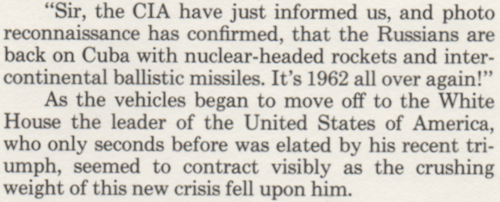
Periscope Red begins twenty-three days later. What happened to the missiles in Cuba? Why no talk of the deadly natural gas shortage? You’d think that the Ruskies blowing up supertankers would put an end to the glut that the US sought to exploit? And, really, what's the point of spending all that money on ships only to see them sink?
Here's my theory: Balls! hit bookstores in August 1979, two months before the Soviet intervention in Afghanistan. Rohmer decided that real life was far better than his Cuban Crisis Revisited idea. Bonus: All his thinking about World War III would still apply.
A parting query regarding Yasser Arafat: Am I right that Periscope Red is the first Rohmer novel to feature a real person?
And is that not the same Yuri Andropov we grew to know and love during his final fifteen months? Perhaps not, before becoming Chairman ours headed the KGB, not the Red Army. I'm betting Rohmer was just drawing upon names he knew - hence Romanov, Smirnov, Ustinov (but not Nabokov, Bulgakov or Chekhov).
Sayeth General Andropov:
Triad? Of course, 'cause, you know, it’s the sequel.
You have to remain alert if you want to catch any of Rohmer's quirks. Here are a few I spotted:
A chapter that begins: “To sum up the main points of the briefing Mr. President…”
Hyperbole: “I think it’s safe to say that the next six days will be the most crucial between the Americans and the Russians since World War II.”
Uninformed politicians: President Hansen discovers that the Chairman of the Joint Chiefs of Staff objects to the Pakistan deployment by reading about it in The New York Times (which in turn considers the story warrants no more than a small article beneath the fold).
Stupid politicians: While Hansen is certain that the Soviet Union is the only country processing the ability to sink twenty supertankers in the Atlantic, he doesn’t rule out “revolutionaries”.
Inconsistency: Is it Japanese Red Brigade or Japanese Red Army?
Forgetfulness: What do those Germans call themselves? Badd…? Badder…? Screw it, “the dreadful gang of German revolutionaries” and “the German revolutionary group” will do.
Weirdness: Much like Thomas Jefferson and Canada, Chairman Romanov is certain that taking over the Middle East will be a mere matter of marching.
Finally, we have the significance of race, blood, or in this case genetics:
Said was a Palestinian Arab. And yet he also carried an unusual genetic strain of which his blue eyes were the manifestation. It was this combination that set him apart and provided for him special initiatives. He thought as did his Arab fellows but unlike them he did not rant, rave and merely talk. He could act.Here’s Said with Captain Rashid as imagined by
True, Periscope Red lacks a protagonist, but then À rebours has no plot. Consider it an experiment. For the first time Rohmer abandons no threads. All thin, they simply run along, barely rising or falling. And while they’re not exactly tied at the end, they do touch. That is, if one forgets that Periscope Red is the sequel to Balls!
Remember how that ended?
Periscope Red begins twenty-three days later. What happened to the missiles in Cuba? Why no talk of the deadly natural gas shortage? You’d think that the Ruskies blowing up supertankers would put an end to the glut that the US sought to exploit? And, really, what's the point of spending all that money on ships only to see them sink?
Here's my theory: Balls! hit bookstores in August 1979, two months before the Soviet intervention in Afghanistan. Rohmer decided that real life was far better than his Cuban Crisis Revisited idea. Bonus: All his thinking about World War III would still apply.
A parting query regarding Yasser Arafat: Am I right that Periscope Red is the first Rohmer novel to feature a real person?
And is that not the same Yuri Andropov we grew to know and love during his final fifteen months? Perhaps not, before becoming Chairman ours headed the KGB, not the Red Army. I'm betting Rohmer was just drawing upon names he knew - hence Romanov, Smirnov, Ustinov (but not Nabokov, Bulgakov or Chekhov).
Sayeth General Andropov:
The Americans never cease to amaze me with their inability to plan ahead for this sort of crisis. They seem to be completely incapable of doing any sort of long-term planning.Yep, every Rohmer plot tells us as much.
Triad? Of course, 'cause, you know, it’s the sequel.
Monday, 7 April 2014
When you're writing a screenplay, they tell you to think about the poster. Can an audience understand it, just from that? I guess Periscope Red would make an okay movie poster. Submarines, terrorists, the White House... but you could never cast it. Because there aren't any characters. No lead, no villain, no sidekick, no love interest. No henchman, no double-agent, no dead child or disappointed father in the hero's past. No ex-wife, no chief who tells the hero to play this one by the book. No mentor, no reporter, no genius hacker. No villain's girlfriend. No nothing.
It's like some sort of bizarre exercise, like writing a novel without the letter "a."
Here's what happens in Periscope Red.
Palestinian terrorists get on a freighter with a mysterious cargo of super mines. (The Palestinians, for reasons known only to Richard Rohmer, are working for the Soviet Union, and against the interests of the Arab oil states. This isn't a plot point. It just is. They're just doing it... because. They're basically the Beagle Boys.) Meanwhile, the President of the United States decides to send troops to Pakistan. This angers the Russians. A British submarine encounters a device that blocks sonar. This means Russian submarines can get into the South Atlantic without being detected. The Russians tell the Americans to take their troops out of Pakistan. The Americans say no. The Palestinians use their super mines to blow up a lot of oil tankers. The Russians use their submarines to blow up a lot of tankers. The British submarine doesn't get sunk at first, but then it does. This means war the end.
And it's unbelievably boring. I mean, it's excruciating. Not only does it go on and on, but it has so little drive it gives you a sensation of learned helplessnes, because there's nothing building. So you can't imagine how (if ever) it could possibly end. And you realize it's not building because it's Rohmer, so there's going to be a cliffhanger instead of an ending. It's awful. It's easily his worst book yet.
Because no one does anything.
It doesn't even have any howlers about sex and natural gas.
Sure, it makes as little sense as the classic early Rohmers: Why does the plan require the Palestinians at all? Why not just have the Russian submarines sink all the tankers? And why does Yasser Arafat issue a statement about sinking some but not others? Why not all of them? Or none?
But the fun is gone.
I think there's one great line, after the President has sex on Air Force One, about the First Lady's "satisfied thighs," but nothing could make me look it up. I'm not going through that hell again.
Triad, boys?
It's like some sort of bizarre exercise, like writing a novel without the letter "a."
Here's what happens in Periscope Red.
Palestinian terrorists get on a freighter with a mysterious cargo of super mines. (The Palestinians, for reasons known only to Richard Rohmer, are working for the Soviet Union, and against the interests of the Arab oil states. This isn't a plot point. It just is. They're just doing it... because. They're basically the Beagle Boys.) Meanwhile, the President of the United States decides to send troops to Pakistan. This angers the Russians. A British submarine encounters a device that blocks sonar. This means Russian submarines can get into the South Atlantic without being detected. The Russians tell the Americans to take their troops out of Pakistan. The Americans say no. The Palestinians use their super mines to blow up a lot of oil tankers. The Russians use their submarines to blow up a lot of tankers. The British submarine doesn't get sunk at first, but then it does. This means war the end.
And it's unbelievably boring. I mean, it's excruciating. Not only does it go on and on, but it has so little drive it gives you a sensation of learned helplessnes, because there's nothing building. So you can't imagine how (if ever) it could possibly end. And you realize it's not building because it's Rohmer, so there's going to be a cliffhanger instead of an ending. It's awful. It's easily his worst book yet.
Because no one does anything.
It doesn't even have any howlers about sex and natural gas.
Sure, it makes as little sense as the classic early Rohmers: Why does the plan require the Palestinians at all? Why not just have the Russian submarines sink all the tankers? And why does Yasser Arafat issue a statement about sinking some but not others? Why not all of them? Or none?
But the fun is gone.
I think there's one great line, after the President has sex on Air Force One, about the First Lady's "satisfied thighs," but nothing could make me look it up. I'm not going through that hell again.
Triad, boys?
Subscribe to:
Posts (Atom)