Showing posts with label Anachronisms. Show all posts
Tuesday, 6 January 2015
Lying Russians and Lazy Irishmen
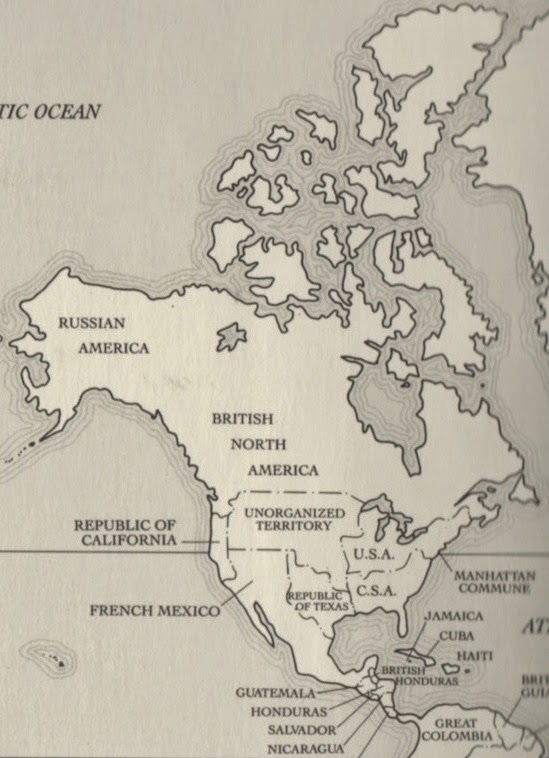
Now that we've all three finished John A.'s Crusade, I can finally mention my chief complaint: The sale of Alaska to the Americans.
Yes, we all knew it was going to happen. The anachronisms are accidents – Rohmer didn't mean to set the novel in an alternate universe.
My question is why. Why does Russia decide to sell the Alaska to the Americans?
As I remember it – please keep in mind that it's been more than six weeks since I finished this thing – all comes down to the Russians saying one thing and doing another. As Rohmer's novels teach, drunk or sober, Russians can't be trusted. Fair enough, but given that this is the decision around which the whole plot turns I expected more.
Or do I simply not remember?
In her Globe & Mail review (20 May 1995), Elizabeth Abbott writes: "Rohmer deals with this in a startling denouement in which we learn what Macdonald never did: precisely why the czar changed his mind."
Is Elizabeth Abbott right?
Am I wrong?
In the latter case, allow me to save face by correcting Professor Abbott: Our first prime minister didn't actually leave the London Conference for a top secret meeting with Alexander III.
A final complaint (because, really, after two months shouldn't we be done with it?): The half-hearted Fenian attempt on Macdonald's life. Coulda stabbed him as he slept. Coulda shot him through the heart. Instead, his room is set alight, the flames so weak that the rest of the hotel patrons sleep undisturbed.
The Fenians were never so subtle. For goodness sake, they shot D'Arcy McGee through the head a block from Parliament Hill! With Macdonald, some kid named Kelly – sorry, Chris – botches the job, after which they just give up. I was reminded of nothing so much as the Mafia's brutal attack on Paul James, Franz Huber and his ugly daughter in Retaliation. That was really something! But after it failed everyone went home, never to speak of it again.
Ah, well, at least they tried.
Thursday, 1 January 2015
Language
Resplendent with anachronisms
As Brian points out in his post, Rohmer's use of "bullshit" is an anachronism, but the book is littered with them. People speak to each other like we're in the world of Ultimatum! A few other examples (and there are more; I gave up writing them down halfway through):
- The word "stereotype" is used to denote personality traits. Although the word existed as a printing term, it wasn't used in this sense until 1922.
- "Anyway, I've beaten those lah-de-dah snobs at their own game" - the word "la-di-da" first appeared in 1889.
- "I wanted to get all my ducks in a row" The expression "ducks in a row" first appeared in an article in the Washington Post in 1932.
As time is always of the essence (I know this because the expression is used), I kept expecting someone to get on a plane to make a secret meeting in China to discuss the deal.
Don't trip on your metaphor on the way out
"Without changes to that Treaty we'll probably never make a deal with the two-headed Russian Eagle."
Galt grunted. "Eagles. You're up against two proud, friendly eagles, John A. Friendly with each other, that is."
The intense pain from Macdonald's shoulder made him wince as he agreed. "I hadn't thought of it before, but you're right. I'm up against eagles - those two at any rate."
"And you and I, John A, an all of us here must do everything in our power to defeat the American eagle and its Manifest Destiny while we convince the Tsar or all the Russias that his powerful two-headed eagle should deposit its Russian American egg safely - and at an enormous price in gold - in our Canadian nest."
Macdonald paused, then announced, "After that flight of oratory in the presence of excruciating pain, Alex, I think I deserve a tumbler of the best whisky."
As do the readers.
(no idea why Russian Eagle is capitalized and American eagle isn't, but I'm just transcribing here, not correcting)
As Brian points out in his post, Rohmer's use of "bullshit" is an anachronism, but the book is littered with them. People speak to each other like we're in the world of Ultimatum! A few other examples (and there are more; I gave up writing them down halfway through):
- The word "stereotype" is used to denote personality traits. Although the word existed as a printing term, it wasn't used in this sense until 1922.
- "Anyway, I've beaten those lah-de-dah snobs at their own game" - the word "la-di-da" first appeared in 1889.
- "I wanted to get all my ducks in a row" The expression "ducks in a row" first appeared in an article in the Washington Post in 1932.
As time is always of the essence (I know this because the expression is used), I kept expecting someone to get on a plane to make a secret meeting in China to discuss the deal.
Don't trip on your metaphor on the way out
"Without changes to that Treaty we'll probably never make a deal with the two-headed Russian Eagle."
Galt grunted. "Eagles. You're up against two proud, friendly eagles, John A. Friendly with each other, that is."
The intense pain from Macdonald's shoulder made him wince as he agreed. "I hadn't thought of it before, but you're right. I'm up against eagles - those two at any rate."
"And you and I, John A, an all of us here must do everything in our power to defeat the American eagle and its Manifest Destiny while we convince the Tsar or all the Russias that his powerful two-headed eagle should deposit its Russian American egg safely - and at an enormous price in gold - in our Canadian nest."
Macdonald paused, then announced, "After that flight of oratory in the presence of excruciating pain, Alex, I think I deserve a tumbler of the best whisky."
As do the readers.
(no idea why Russian Eagle is capitalized and American eagle isn't, but I'm just transcribing here, not correcting)
Monday, 24 November 2014
I raced through Sir John A.'s Crusade, but only because the copy I had was an inter-library loan and could not be renewed.
Here are a few things to look out for:
Bullshit
Rohmer imagines at least two characters – Robert Wilmot and George-Étienne Cartier – uttering the word. Fathers of Confederation both, I felt this was in poor taste, doubly so since its use can be traced back no further than 1915 America.
Errors in calculation
Foul-mouthed Cartier pegs Macdonald's age at 52. In fact, he was 51.
Macdonald describes the year in which all action takes place as the twenty-ninth in Victoria's reign. In fact, it is the thirtieth.
Exclamation marks
I'm certain that there are more here than in any other Rohmer novel.
Kelly
Rohmer likes to position himself as something of a seer.
"Balls!" you say. "The man couldn't have been more wrong about the Soviet Union."
"True enough," I reply, "but consider last week's events in Buffalo. One of the dead was found in a car covered by snow."
As if further evidence was needed that Rohmer is in tune with Geller, I point out that Sir John A.'s Crusade features a villain with the very same surname as one of his future critics.
Resplendent
Reading Richard Rohmer, you begin to recognize common threads. Vodka and how to dull its effects is one example. Not everything is so obvious. It wasn't until Sir John A.'s Crusade that I first noticed "resplendent", a word I don't think I've ever used in my own writing.
Going back, I see that it was there from the beginning. In Ultimatum we find members of the RCMP "resplendent in their traditional red-coated uniforms". It's used in describing Patton's garb in Patton's Gap. The word appears in Red Arctic and – spoiler – Rohmer's biography of E.P. Taylor. Resplendent is used four times in Generally Speaking. It also appears four times in Sir John A.'s Crusade. Which brings me, finally, to…
Fetishism
You'll not find so shameless a display of perversity as this passage from Sir John A.'s Crusade:
The Right Honorable Henry Wellesley, Earl Cowley, was resplendent in his ambassador's uniform. He wore a black jacket, with a high collar and epaulettes; the gold braid decorating it was enhanced with royal reds and blues. A crimson sash crossed from the right shoulder to the opposite hip; half a dozen medals on multi-coloured ribbons were pinned to the left side of the jacket, over the ambassador's chest. Below them sat thge star of his rank with which his Queen had vested him. His black trousers bore wide gold stripes down the outside seams. Those stripes disappeared into highly polished half-Wellington boots.There's more, but you get the picture.
A short ceremonial sword in an elaborately engraved and embossed scabbard hung from a broad gold-decorated belt that encircled Earl Cowley's considerable girth. On his head sat, foursquare, a large black cocked hat covered with more gold braids, its forward point jutting straight out from his wigless wide forehead. Across the hat's crest several white plumes…
Lest you wonder, I don't mention the "busby-capped soldiers of Her Majesty's Grenadier Guard" because "resplendent" is not used.
Yes, I am hurt.
Labels:
Anachronisms,
Balls!,
Bullshit,
Cartier,
E.P. Taylor,
Fenians,
Fetishism,
Generally Speaking,
John A.'s Crusade,
Macdonald,
Patton's Gap,
Red Arctic,
Resplendent,
Ultimatum,
Vodka,
Wellesley,
Wilmot
Subscribe to:
Posts (Atom)

